

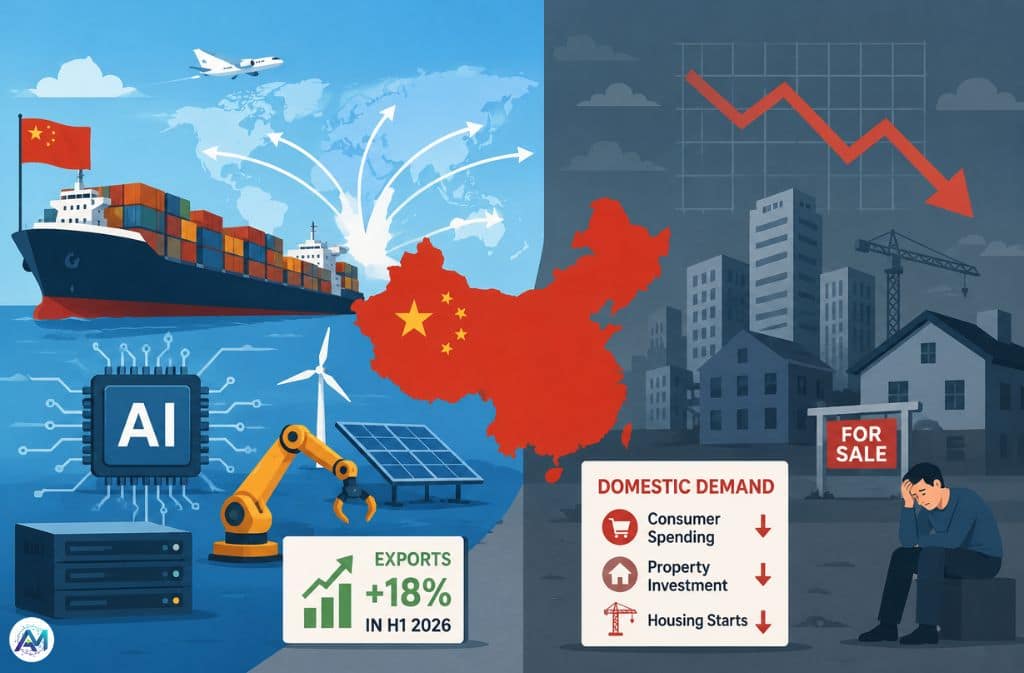
China’s export machine is running hot again, and AI is doing most of the pulling. Exports grew 18% year-over-year in dollar terms in the first half of 2026. More than half of that growth traces back to AI, directly or indirectly, according to Haining Zha, Vice President and Director of Asset Allocation Research at TD Asset Management.
Strip AI out of the number, and export growth still holds at a healthy 8-9%. Put it back in, and the picture looks a lot stronger than China’s domestic economy actually is.
Here’s what’s driving the gap, and why a record-breaking chip IPO landing this week matters more than the headline growth number.
Is AI Really Driving China’s Export Growth?
Yes, and not just through chips.
Circuits, hardware, and electronics account for more than half of China’s total export growth on their own, Zha said. Power equipment and renewable energy gear ride along behind them, since AI infrastructure needs electricity at a scale that’s now showing up in trade data.
The catch: none of this is translating into strong GDP growth at home. Exports contributed roughly 90 basis points to China’s second-quarter GDP, against final consumption’s 2% and fixed-asset investment’s 1.5%. The export engine is loud. It’s not carrying the whole economy by itself.
Why Is China’s Domestic Economy Still Struggling?
Property remains the drag. Real estate investment fell 18% year-over-year. Housing starts dropped 25%. New floor space sold is down 12-13%.
There’s a real second story underneath those numbers, though. Existing-home transactions picked up in select Tier 1 and Tier 2 cities — Shanghai rose 21% year-over-year in June, Shenzhen climbed 13%. Zha attributes that to three forces: deferred buyers finally moving after prices stabilized, homeowners trading up from aging housing stock, and a smaller but real cohort of people who made money in AI-linked stocks and are now spending it on real estate.
That third group skews high-end. It’s moving dollar volume more than transaction count, but it’s a genuine channel connecting the AI trade to the property market.
What Is CXMT, And Why Does Its IPO Matter?
CXMT — China’s answer to the memory-chip boom that made Nvidia’s suppliers wealthy — lists on July 27. It’s the clearest signal yet of how much capital wants into China’s AI supply chain.
Institutional demand ran 500 times oversubscribed. Retail demand hit over 200 times. Two years ago, CXMT was barely breaking even. This year, it’s projected to earn close to 100 billion RMB. It’s set to list at a valuation near 580 billion RMB, and gray-market pricing points to a first-day pop of four to five times that, which would push its market cap past 2 trillion RMB.
That’s not SpaceX-scale by dollar terms, but inside China, it puts CXMT among the largest listed companies in the country on day one.
How Does Kimi K3 Compare To Western Frontier Models?
Moonshot’s Kimi K3, released just days before this interview, trails Anthropic’s Fable and the current state-of-the-art ChatGPT model on raw capability, according to Zha. It beats Anthropic’s Opus 4.8, though — at roughly a third of frontier pricing, and around 60% of what Opus 4.8 costs.
That combination — near-frontier capability at a fraction of the price — is what Zha calls a point on the Pareto efficient frontier. Chinese labs aren’t necessarily chasing the top benchmark anymore. They’re optimizing the capability-per-dollar curve, and that’s a harder thing for Western labs to compete against on price alone.
Could US Restrictions Choke Off China’s AI Export Advantage?
It’s a real risk, but not a settled one. Zha points out that Washington has weighed gating out increasingly competitive Chinese AI products before, and hasn’t moved decisively. Part of the resistance comes from inside the US itself — a view that cutting off competition could slow the industry’s own progress, and that consumers and enterprises benefit more from Chinese models staying in the market than from walling them out.
That tension sits underneath everything else in this story. China’s export boom depends on foreign buyers staying able to purchase what it’s selling.
Where Are The Real AI Opportunities In China Right Now?
Zha frames it through what he calls Jensen Huang’s five-layer cake: energy, chips, models, applications, and infrastructure. China has genuine strength in most of them.
Energy is a structural advantage — China simply produces more of it. Chips are a forced localization story, driven directly by export bans that turned a policy obstacle into a domestic market opportunity. Models are where Kimi K3 and its peers sit, competing hard on cost-efficiency rather than raw capability alone.
Applications are the layer Zha expects to matter most over time, based on how China executed the mobile and cloud transitions before it — though many of the companies that will dominate that layer, he notes, haven’t been founded yet.
Infrastructure is already visible: Alibaba Cloud is growing 38% year-over-year, backed by China’s traditional strength in construction and industrial buildout for data centers.
The Bigger Picture
China’s AI story right now has two tracks running in parallel. One is genuine industrial strength — export growth, IPO demand, cost-competitive models climbing the efficiency frontier. The other is a domestic economy still leaning on a shrinking property sector and consumption growth well below its own five-year target.
The AI trade is real. Whether it’s big enough to pull the rest of the economy up with it is still an open question — and Beijing’s own policy signals, so far, don’t suggest much urgency to find out.
Related: China Just Killed AI Companions—The Real Reason Has Nothing to Do With Politics