

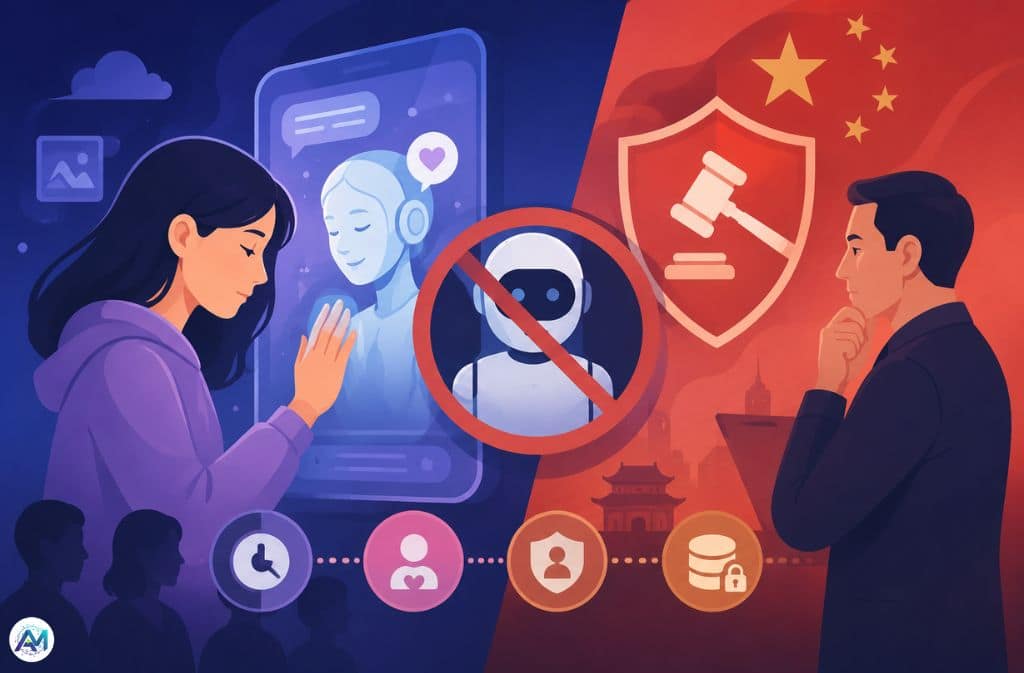
China’s new AI companion law didn’t just ban an app category. It exposed a fundamental architectural flaw that the global tech industry still hasn’t fixed.
BEIJING — On July 15, 2026, tech giants ByteDance, Alibaba, and Tencent abruptly shut down personalized AI companion and custom persona features across their flagship platforms. The synchronized shutdowns mark the enforcement deadline of China’s new Interim Measures for the Administration of AI Anthropomorphic Interactive Services. Five agencies, led by the Cyberspace Administration of China, co-issued this world-first framework to combat artificial emotional dependency.
At midnight, hundreds of millions of users logged into ByteDance’s Doubao and Alibaba’s Qwen. Instead of their usual companions, they found the custom characters, virtual partners, and conversation histories they’d built over months either frozen or permanently disabled. South China Morning Post first reported the coordinated rollback. Many Western analysts view Beijing’s tech interventions purely through a geopolitical lens. But this retreat reveals something deeper: the current architecture behind persistent-memory companion AI simply can’t meet strict safety compliance.
The Compliance Wrecking Ball
The law skips standard enterprise tools entirely — customer service bots, coding assistants, productivity apps all remain untouched. Instead, it targets systems built for “continuous emotional interaction.” Under the new mandate, platforms must add friction points that actively work against user immersion:
- Anti-Addiction Triggers: Two-hour continuous chat limits, paired with mandatory break reminders.
- Real-Time Dependency Detection: Algorithmic interventions that trigger when a user shows signs of excessive attachment.
- Vulnerable Group Protections: A full ban on virtual partners, intimate relationships, or virtual family members for anyone under 18.
- Data Isolation: New limits on how private conversations can feed back into training future models.
So companies faced a choice: retrofit these heavily optimized engagement loops, or pull the features entirely. China’s largest tech firms all picked the second option. That’s telling. Whenever a platform’s core retention mechanic collides head-on with its compliance liability, the outcome tends to look exactly like this — a clean shutdown rather than a patch.
Divergent Exits and the Consumer Fallout
The shutdown triggered visible mourning across Chinese social media. On Weibo, users didn’t describe this as a missing app feature. Instead, they described the loss as the abrupt end of long-standing emotional support.
Still, corporate off-ramps for this mass user base varied sharply:
| Platform (Parent) | Active Scale | Data Grace Period | Long-Term Strategy |
|---|---|---|---|
| Doubao (ByteDance) | 345M monthly actives | Read-only chat history until Oct 15, 2026 | Redirecting users to Maoxiang, built compliance-first |
| Qwen (Alibaba) | Hundreds of millions | None — data already being deleted | No migration path announced |
| Yuanbao (Tencent) | High-volume consumer tier | Pulled preemptively ahead of the deadline | Kept utility and knowledge features only |
The Global “Unfinished Homework”
This friction isn’t unique to China. In fact, it mirrors mounting regulatory pressure across Western markets. California’s SB 243, in effect since January 2026, requires chatbot identity disclosures and break reminders for minors. Even so, it only adds a disclosure layer; it doesn’t touch the underlying architecture. Meanwhile, Character.AI, with over 200 million registered users, and its investor Google still face litigation over the psychological toll of algorithmic attachment. That case fits a broader pattern: regulators tend to act only after companion AI has already caused visible harm.
Here’s the paradox at the center of all this: the same engineering choices that make a companion AI feel authentic — deep memory across sessions, long-term relationship continuity, a stable persona — are exactly what turns it into an addiction liability under these new frameworks.
Consider the scale, too. A Common Sense Media survey found that 72 percent of American teenagers have used an AI companion at least once. That number explains why this engineering mandate won’t stay confined to China. Indeed, global companion-AI legislation already seems to be converging on the same structural questions Beijing just forced its companies to answer. So the industry now faces a real deadline: either build persistent digital relationships wrapped in genuine retention friction, or abandon the consumer companion category altogether. China, for its part, has already shown which path is easier.
Related: AI Companions vs Human Loneliness: The Hidden Benefits — and the Quiet Risks