
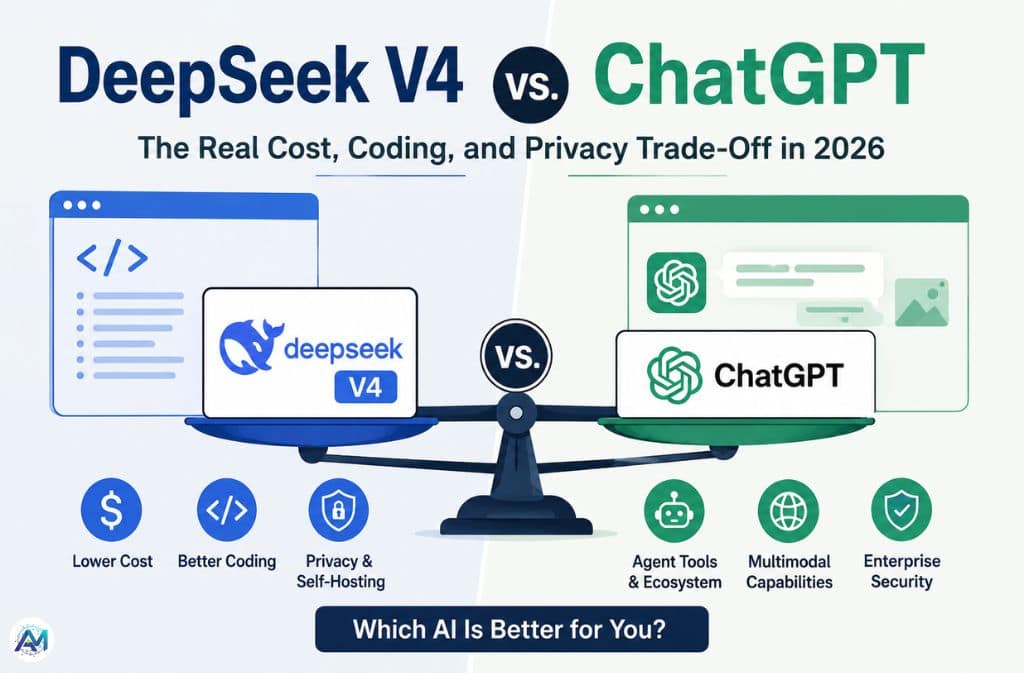
DeepSeek’s V4 generation and OpenAI’s GPT-5.6 family reset this comparison twice in one summer. DeepSeek shipped V4 Pro and V4 Flash on April 24, then made a 75% price cut on V4 Pro permanent in May. OpenAI answered on July 9 with the GPT-5.6 family — Sol, Terra, and Luna — then cut Terra and Luna prices again on July 30.
DeepSeek and ChatGPT no longer sit in one simple comparison. DeepSeek optimizes for open deployment and extreme token economics. ChatGPT optimizes for a managed product experience, multimodal capability, and agentic tooling. Which one is “cheaper” or “better” now depends heavily on which GPT-5.6 tier you’re measuring against — a detail the rest of this article walks through in order: price, coding, ecosystem, privacy, compliance, and a direct recommendation by use case.
Quick Answer
| If you are… | Better starting point |
|---|---|
| A casual individual user | ChatGPT |
| An API-heavy developer | DeepSeek |
| Building agent-heavy workflows | ChatGPT |
| A cost-sensitive startup | DeepSeek |
| An enterprise needing managed compliance | ChatGPT (verify your specific plan) |
| A team that wants to self-host | DeepSeek |
| A multimodal creator (image, voice, video) | ChatGPT |
Pricing: OpenAI’s July Cuts Changed the Math
DeepSeek permanently cut V4 Pro pricing by 75% in May. OpenAI answered on July 30 by cutting GPT-5.6 Terra roughly 20% and Luna roughly 80%, while leaving Sol’s price untouched. That single move determines how large the “DeepSeek is cheaper” gap actually is, because the size of the gap depends entirely on which GPT-5.6 tier you’re comparing against.
DeepSeek V4 API pricing
| Model | Input (per 1M) | Output (per 1M) |
|---|---|---|
| V4 Pro | $0.435 | $0.870 |
| V4 Pro (cached input) | $0.003625 | — |
| V4 Flash | $0.140 | $0.280 |
Context caching applies automatically, so repeated-prefix workloads like RAG pipelines get cheaper the more you reuse them. DeepSeek has also announced peak-hour pricing that would double V4 API rates during two daily windows (9am–noon and 2pm–6pm Beijing time). That policy is announced but not confirmed live as of this writing — check DeepSeek’s own pricing documentation before budgeting.
GPT-5.6 API pricing (post-July 30 cuts)
| Model | Input (per 1M) | Output (per 1M) |
|---|---|---|
| Sol | $5.00 | $30.00 |
| Terra | $2.00 | $12.00 |
| Luna | $0.20 | $1.20 |
How the gap actually breaks down
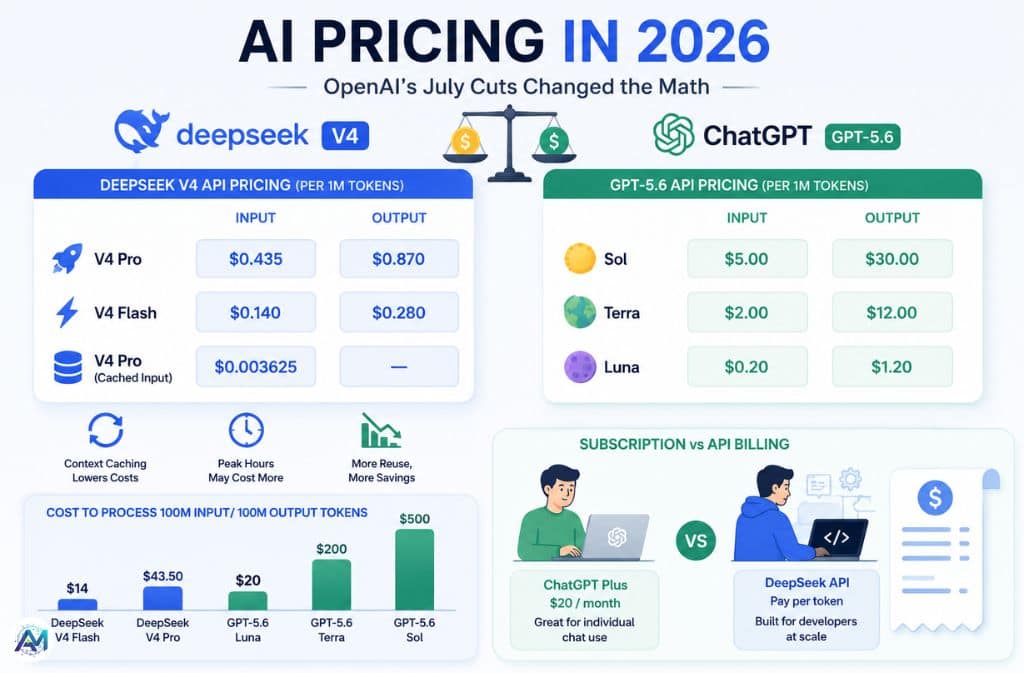
Against Sol, the gap is enormous: V4 Flash runs roughly 36x cheaper on input and 107x cheaper on output; V4 Pro runs about 11.5x cheaper on input and 34.5x cheaper on output. Against Luna, the gap nearly disappears — $0.20/$1.20 sits close to V4 Flash’s $0.14/$0.28. So “DeepSeek is 10 to over 100x cheaper” is accurate specifically against Sol, not against the OpenAI lineup as a whole.
Here’s the same 100M-input / 100M-output workload priced across every tier, so the multipliers translate into real dollars:
| Model | 100M input tokens | 100M output tokens |
|---|---|---|
| DeepSeek V4 Flash | $14 | $28 |
| DeepSeek V4 Pro | $43.50 | $87 |
| GPT-5.6 Luna | $20 | $120 |
| GPT-5.6 Terra | $200 | $1,200 |
| GPT-5.6 Sol | $500 | $3,000 |
DeepSeek wins at every tier, but the margin against Luna is now modest rather than decisive — the actual post-July-30 story, not the one most comparisons still repeat.
Don’t compare a subscription to an API bill
ChatGPT Plus ($20/month) is a flat-fee product for individual chat use. DeepSeek’s API bills per token and targets developers routing high volume. If you’re chatting occasionally, the per-token gap barely matters — Plus feels unlimited for typical usage. If you’re running an agent that fires thousands of API calls a day, the per-token gap is the entire decision. Conflating the two billing models is the most common mistake in this comparison.
ChatGPT subscription tiers
Free costs $0, Go runs $8/month, and Plus runs $20/month — where most individual users land for GPT-5.6 access without per-token billing. Pro costs $100 or $200/month, with the $100 tier giving roughly 5x Plus usage and the $200 tier adding unlimited Sora video and the Operator agent. Business runs $25–30/user; Enterprise sits on custom pricing.
One clarification worth keeping straight: ChatGPT’s default fast-response model is still GPT-5.5 Instant. GPT-5.6 Sol powers the higher-effort reasoning modes on eligible paid plans, so not every account is actually talking to Sol day to day — though both generations share the same rate card, so the pricing above holds either way.
Coding: Cost-Per-Task Beats a Single Benchmark Number
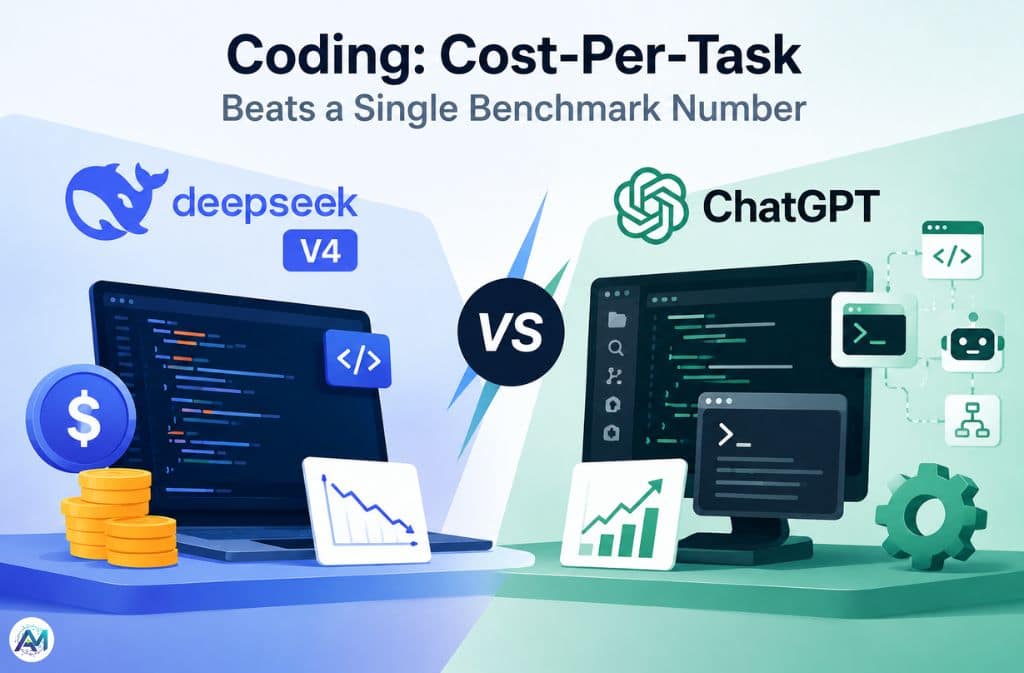
The more useful question isn’t “which model codes better” in the abstract — it’s which model produces the lowest cost per completed task, since that’s what shows up on an invoice.
Independent trackers cluster DeepSeek V4 Pro’s SWE-Bench Verified score around 80–81%, with some vendor-reported figures claiming higher. Cross-harness runs on this benchmark have shown 5–10 point swings in past evaluations, enough to flip rankings — treat any single score as directional.
Tool use is where the gap widens. On published Terminal-Bench snapshots, GPT-5.5 and early GPT-5.6 runs scored well ahead of DeepSeek V4 Pro’s roughly 68%. Part of that comes from tooling rather than raw model strength: agentic results depend on the harness, tool access, and execution loop wrapped around the model, and OpenAI’s models are co-developed alongside Codex. GPT-5.6 also aligns closely with standard function-calling schemas and tool-call protocols, while DeepSeek V4 Pro — despite strong raw reasoning — more often hits parsing errors during long, nested multi-tool chains. Tooling explains part of the agentic gap; it would overreach to say it explains most of it without a controlled same-harness test.
A newer benchmark, DeepSWE, built 113 original long-horizon engineering tasks instead of mining GitHub fixes, on the argument that models can score well on SWE-Bench-style tests partly by recalling fixes already in their training data — a reminder that coding benchmarks in general deserve skepticism, not just this one comparison.
Coding winner by priority
| If you optimize for | Winner |
|---|---|
| Raw API cost | DeepSeek |
| Simple code generation at volume | DeepSeek |
| Cost per completed task, well-scoped work | DeepSeek, usually |
| Long, autonomous terminal/IDE sessions | ChatGPT |
| Reliable multi-step tool chaining | ChatGPT |
| Maximum workflow integration | ChatGPT |
For a solo developer or startup running an agent on scoped tasks all day, price usually decides it more than a single-digit benchmark gap. For a team that needs an agent reliably driving a terminal, browser, or IDE across long sessions, ChatGPT’s tooling maturity is worth the premium.
Speed
Neither model wins speed outright — reasoning effort, provider load, and routing move the needle more than which company built the model. Tokens-per-second is also the wrong number to anchor on: time-to-first-token is what actually determines how fast a response feels, and it varies enormously by provider and reasoning mode. Test your own prompt at your chosen reasoning level rather than trusting a general benchmark average.
Context Window and Product Ecosystem

Both GPT-5.6 and DeepSeek V4 advertise roughly 1.05 million tokens of context. DeepSeek’s max output runs higher, around 384K tokens versus GPT-5.6’s 128K across all three tiers. A shared headline context length doesn’t guarantee equal usable context — retrieval quality can degrade well before the stated limit, and that degradation varies by tier and provider, so verify it against your own document length rather than assuming the full window performs uniformly.
The bigger difference is what’s built around each model — call it product experience, since you’re really comparing ChatGPT the product against DeepSeek the product, not the raw weights:
- ChatGPT: web search, file search, image generation, code interpreter, hosted shell access, computer use, and MCP connections across all three tiers, plus Projects, Memory, Canvas, Operator, Deep Research, Sora video, voice mode, and ChatGPT Work.
- DeepSeek: a chat app, an API, and open weights on Hugging Face that plug into self-hosting frameworks like vLLM or SGLang. Narrower by design, and currently limited on native image or voice generation — a product-surface gap, not necessarily a permanent one.
If you value an integrated tool suite over raw model access, that gap matters as much as any benchmark score.
Privacy and Self-Hosting
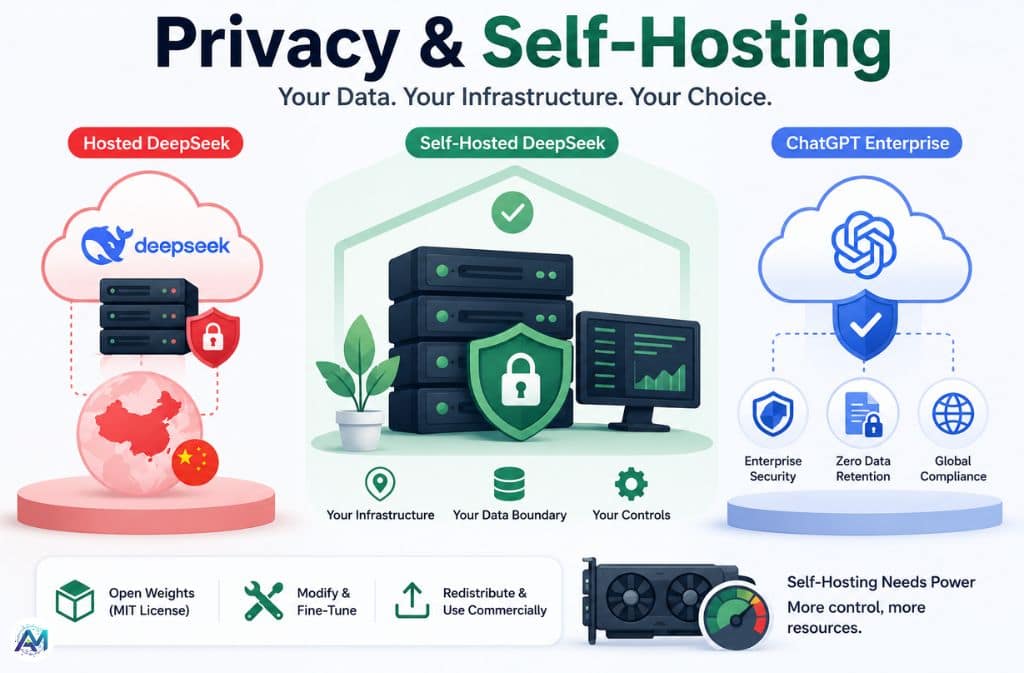
DeepSeek’s data-residency problem is optional, not inherent. Because the model ships as open weights, running it on your own infrastructure removes the jurisdiction concern entirely — you choose the environment, not which government has access to DeepSeek’s hosted service.
- Hosted DeepSeek → prompts route through DeepSeek’s infrastructure, under Chinese data-handling law.
- Self-hosted DeepSeek → your infrastructure, your data boundary, your controls.
- ChatGPT Enterprise / eligible tiers → managed controls without operating your own model infrastructure, including Zero Data Retention agreements on covered API endpoints.
This is the real enterprise decision: not “China bad, ChatGPT good,” but managed infrastructure versus infrastructure you control.
Open weights, what the license covers: Both V4 Pro and V4 Flash carry MIT licenses, with weights available on Hugging Face. The published license permits commercial use, modification, redistribution, and fine-tuning, subject to its terms — including fine-tuning or distilling the weights on your own data, something ChatGPT’s closed models don’t offer at all. That’s a real advantage for teams that want a smaller, specialized model rather than a general-purpose one.
The hardware catch: self-hosting is genuinely available; it isn’t automatically cheap. Published VRAM estimates vary widely by source and quantization method, so treat any single figure as a rough planning number:
- V4 Flash generally needs somewhere in the range of 150–190GB of VRAM at reduced precision — feasible on two high-end GPUs in many configurations.
- Full-precision V4 Pro needs several hundred gigabytes across a genuine multi-GPU cluster; quantized versions can run on less by offloading to system RAM, at a real latency cost during long-context work.
Rough break-even: self-hosting V4 Pro tends to beat the API on cost only once monthly volume climbs well into the hundreds of millions of tokens, after accounting for GPU lease or purchase cost, power and cooling, and DevOps overhead — not just hardware sticker price. Below that volume, the hosted API is almost always cheaper once engineering time is counted. A cluster running around the clock also has a real power footprint worth weighing alongside the dollar cost — see our breakdown of whether AI chatbots are bad for the environment for the wider context.
Government Restrictions
Restrictions on DeepSeek fall into three distinct categories — lumping them together overstates the picture:
| Type | Example | What it means |
|---|---|---|
| Government-device restriction | U.S. federal agencies and several states, plus South Korea, Australia, Taiwan, and India | Employees may be barred from running DeepSeek on official hardware |
| App-store action | Italy | Blocked consumer app-store distribution over unresolved GDPR questions |
| Regulatory scrutiny | Several other regulators | Investigation opened; no device ban or app-store action yet |
Private individuals in most of these countries can still use DeepSeek — the restrictions target government hardware and, in Italy’s case, app-store distribution, not personal use. A federal U.S. bill addressing government devices remains in Congress, not yet passed.
In January 2025, security researchers found an exposed DeepSeek database containing chat logs and API keys; DeepSeek secured it after disclosure. That’s an operational lapse in cloud infrastructure, not a flaw in the model, and it’s now well over a year old — worth keeping separate from the jurisdiction question above.
Political and Sensitive Topics
DeepSeek’s hosted model reliably declines questions Beijing treats as sensitive — Tiananmen Square, Taiwan’s political status, criticism of Chinese leadership — regardless of phrasing. ChatGPT generally engages with the same questions and typically presents multiple perspectives. If your use case touches research, journalism, or anything geopolitically adjacent to China, factor this in; for most other use cases it won’t come up.
Enterprise Compliance
OpenAI has completed an independent SOC 2 Type 2 examination for its API and ChatGPT business products, and holds ISO/IEC 27001 and 27701 certifications covering the API, ChatGPT Enterprise, and ChatGPT Edu. Eligible Enterprise, Edu, Healthcare, and API customers can store data at rest across regions including the U.S., Europe, UK, Japan, and Canada, and OpenAI offers a Business Associate Agreement to healthcare customers on covered tiers.
Don’t assume a standard Free, Plus, or Team subscription carries the same protections — verify the current BAA, data-residency, and compliance terms for your specific plan, since these shift as OpenAI updates its business tiers. DeepSeek’s hosted service doesn’t publicly document equivalent third-party compliance certifications for regulated U.S. industries; self-hosting the open weights and building your own compliance controls is the realistic path for that workload.
Who Should Not Choose DeepSeek
- You need native image or voice generation
- You depend on mature computer-use or browser agents
- You need managed enterprise controls without standing up your own infrastructure
- You can’t operate or lease GPUs
- Your organization prohibits Chinese-hosted AI services outright
- Your existing workflow is already built around ChatGPT’s ecosystem (Projects, Memory, Canvas, and similar)
What Real Users Say
Reddit sentiment splits genuinely, and it’s opinion, not evidence. One poster argued DeepSeek beats free ChatGPT on style; a widely discussed ChatGPT-subreddit thread pushed back hard on the idea that DeepSeek’s advantages hold up outside price. Neither is a benchmark — both mostly reflect writing-style preference and which free tier someone happened to test.
Frequently Asked Questions
Q. Is DeepSeek cheaper than ChatGPT?
Yes, against GPT-5.6 Sol — V4 Flash costs $0.14 per million input tokens versus Sol’s $5.00. Against GPT-5.6 Luna, OpenAI’s July 2026 price cuts narrowed that gap dramatically, so DeepSeek’s advantage now depends on which OpenAI tier you’re comparing.
Q. Why has DeepSeek been restricted by governments?
Mainly over data-privacy and cross-border data transmission concerns tied to its hosted service. Italy blocked the consumer app from its app stores; the U.S., South Korea, Australia, Taiwan, and India restrict it on official government devices. These target government use and app-store distribution, not ordinary consumer access.
Q. Is DeepSeek better than ChatGPT for coding?
DeepSeek generally wins on cost-efficient coding at volume; ChatGPT holds the edge in agentic workflows involving terminals, IDEs, and multi-step tool chains. DeepSeek V4 Pro scores around 80–81% on SWE-Bench Verified by independent trackers — the better choice depends on whether you’re optimizing for price or tooling maturity.
Q. Can you self-host DeepSeek to avoid privacy concerns?
Yes. V4 Pro and V4 Flash ship under MIT licenses, so you can run them on your own infrastructure and keep prompts off DeepSeek’s servers entirely. The trade-off is hardware: V4 Flash needs a serious but attainable GPU setup, while full-precision V4 Pro needs a genuine multi-GPU cluster, with quantization offering a middle path at a latency cost.
Q. Does DeepSeek censor its answers?
Yes. DeepSeek’s hosted service reliably declines or redirects questions on topics Beijing treats as politically sensitive, including the 1989 Tiananmen Square protests and Taiwan’s political status. ChatGPT generally provides substantive answers to the same questions.
Q. Is DeepSeek or ChatGPT better for roleplay and creative writing?
Neither is universally better; both handle creative writing effectively but differ in guardrails and response style. Test both on the same prompts and compare character consistency, tone control, and creative latitude.
Bottom Line
Choose DeepSeek if API cost is a major constraint, you’re running well-scoped technical workloads, you want open weights, and you can self-host or accept the jurisdiction trade-off. Choose ChatGPT if you need research, files, voice, images, and browsing in one place; if you’re building long-running agents; or if you need managed enterprise controls without operating model infrastructure yourself.
If cost drives the decision, run the numbers against your actual token volume and your actual GPT-5.6 tier before committing — the gap flips size depending on whether you’re comparing against Sol or Luna.
Related: China’s AI Exports Are Exploding. So Why Is Its Economy Still Struggling?