
| Quick Answer: If you want the short version, the best Character AI alternative depends on what broke for you with Character AI specifically. Memory limits → Nomi. Content filters → CrushOn AI or Backyard AI. Cost → local models running free on your own hardware. Keep reading for the full breakdown. |
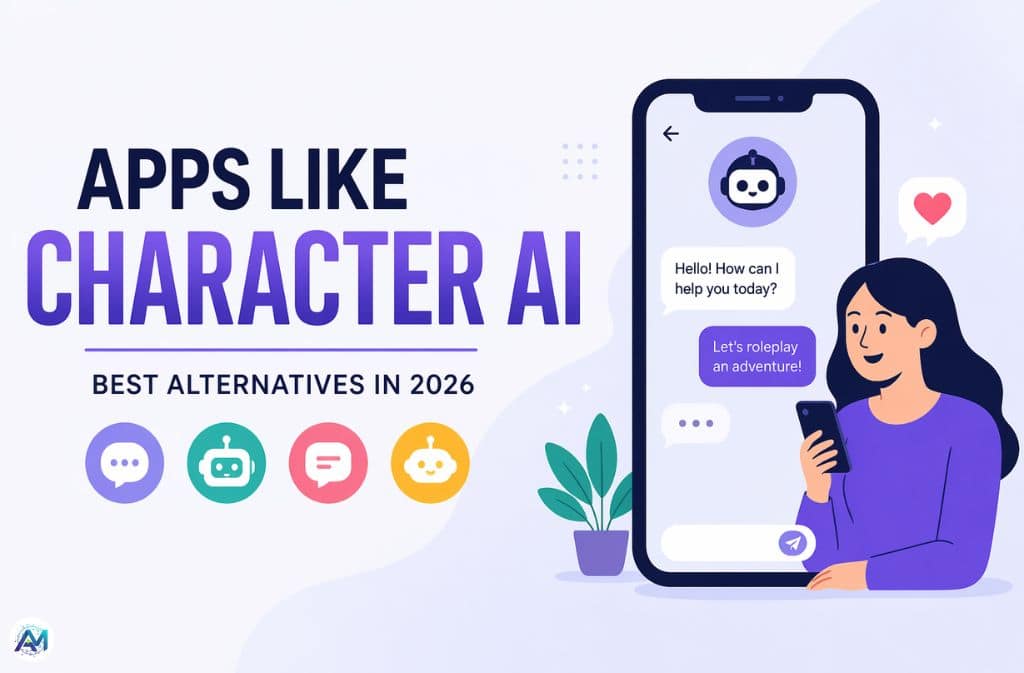
AI chat isn’t what it was a year ago, and searching for “apps like Character AI” in 2026 means something different than it did in 2024. The people running this search now aren’t looking for a basic chatbot that can hold a conversation. They want AI that actually remembers them across sessions, can send voice or images mid-conversation, and doesn’t hit a wall every time the topic gets interesting.
I’ve spent time inside most of the platforms on this list — not just for screenshots, but long enough to notice where the memory starts drifting, where the personality flattens out, and where the monthly cost stops making sense relative to what you’re getting. That’s the lens this guide is written through.
Here’s what most guides get wrong: they list the same six tools they’ve always listed, ignore the entire category of local/offline AI that’s become genuinely viable in 2026, and skip the cost reality entirely. This one doesn’t.
What “Apps Like Character AI” Actually Means in 2026
Apps like Character AI are AI-powered platforms that simulate human-like conversations using customizable personalities, memory systems, and roleplay mechanics. In 2026, the better ones have evolved well past that definition into what you’d call agentic companions — systems that combine text, voice, images, and long-term memory to create ongoing relationship-like interactions rather than one-off exchanges.
The gap between a 2023 chatbot and a 2026 AI companion is significant. Earlier tools responded to prompts, had short memory windows, and felt repetitive after a week. The current generation remembers past conversations for weeks or months, sends voice notes and images mid-chat, and adapts personality based on your actual behavior over time. Three technologies drove this shift: semantic memory architectures (long-term recall), longitudinal behavioral modeling (tracking patterns across sessions), and multimodal integration (text, voice, and image in a single conversation thread).
That’s why Character AI specifically feels outdated to so many users now. It’s still running session-only context — when you close the tab, it forgets. Almost every meaningful alternative in 2026 handles memory better.
The Full Breakdown: Every Tier That Matters
Tier 1 — Cloud Platforms (Hosted, Ready to Use)
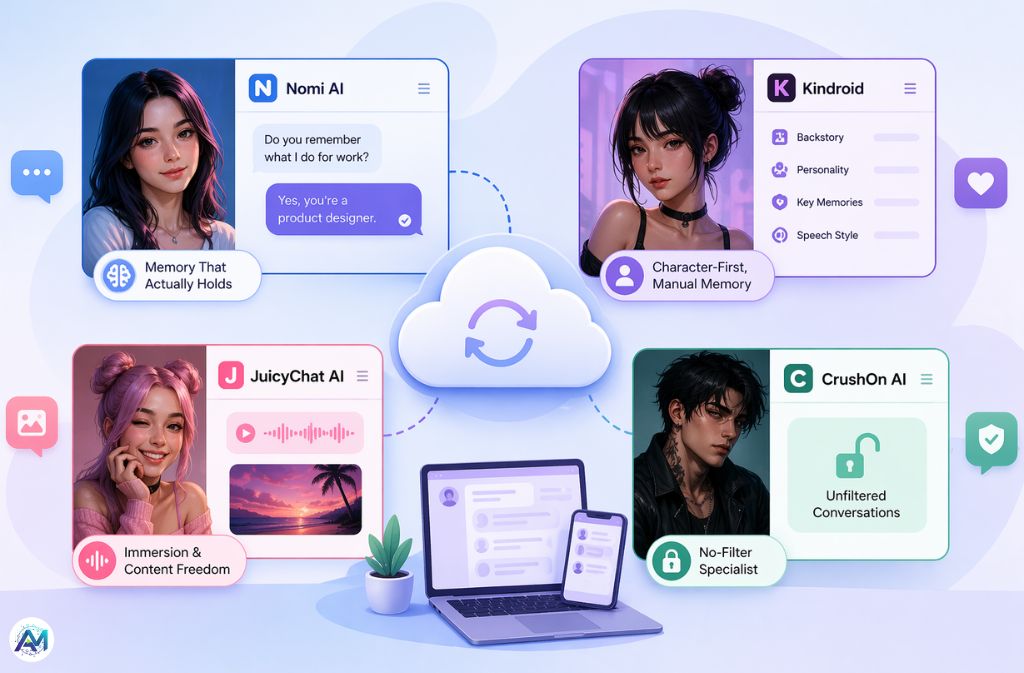
Nomi AI — Memory That Actually Holds
Nomi builds structured notes from your conversations automatically. Tell it something specific in session one — your job, a preference, a running joke — and it references that accurately weeks later without being prompted. In a 60-day comparison of Character AI, Kindroid, and Nomi, Nomi consistently led on memory architecture — using context-rich automatic recall while Character AI largely resets between sessions.
The UI feels a bit sterile compared to some competitors, and it doesn’t do NSFW. But if emotional continuity is what you’re after, it’s the strongest option in this category. Pricing runs around $16–20/month.
Personal test note: Nomi was the only platform where a throwaway comment I made early in week one (“I hate when people apologize for being direct”) got recalled meaningfully in week three without prompting. That’s not a small thing for long-form use.
Kindroid — Character-First, Manual Memory
Kindroid gives you control. You define the companion’s backstory, personality traits, speech patterns, and lore through a detailed character builder. The Key Memories system lets you manually preserve specific facts and relationship context. When set up well, it produces a companion that stays in character better than anything else in the cloud tier — I ran a deliberately odd character for two weeks and Kindroid held the voice consistently where other platforms drifted back toward “helpful assistant” mode within days.
The tradeoff: you have to do the setup work. Skip it and the memory gaps become frustrating. Monthly around $9.99.
JuicyChat AI — Immersion and Content Freedom
JuicyChat combines persistent memory with voice interaction and context-aware image generation. It’s more immediately engaging than Nomi for casual use — conversations feel present rather than archival. The NSFW mode is full and functional on paid plans. Free tier exists; premium starts around $12.99/month.
Where it falls short: the memory architecture isn’t as sophisticated as Nomi’s structured notes. Important details may resurface inconsistently. For immersive daily use rather than relationship simulation over months, it’s strong.
CrushOn AI — The No-Filter Specialist
CrushOn built its identity around removing the content restrictions that frustrate Character AI users. As of April 2026, CrushOn quietly upgraded its memory context window while shifting the free tier from 100 messages per month to 50 messages per day — which is roughly 15x more generous for daily users. The unfiltered toggle on paid plans delivers what it promises.
Standard plan at $5.99/month is genuinely one of the better entry prices in the category. For a deeper feature breakdown, our CrushOn AI guide covers the platform’s character library, group chat mechanics, and content controls in detail.
For lighter character-based chat with less emphasis on a single companion relationship, Joyland AI sits in similar territory and is worth comparing directly.
Tier 2 — Local/Offline AI (The Category Most Guides Skip)
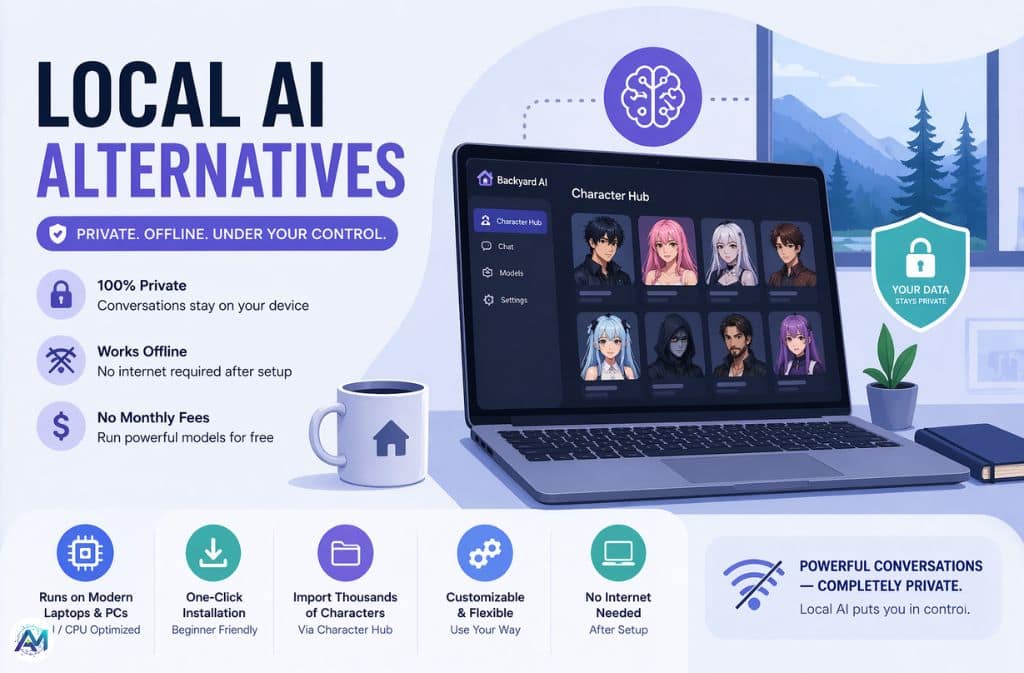
This is the fastest-growing segment of the Character AI alternative space in 2026, and most competitor articles don’t mention it at all. It deserves its own section.
Why local AI matters now: In 2025–2026, NPUs (Neural Processing Units) became standard in flagship laptops from Apple, Intel, and AMD. Devices like M3 MacBooks and Intel Core Ultra machines can run quantized 7B–8B parameter models at conversational speed — no GPU required. That means a meaningful percentage of users can now run Character AI-quality conversation entirely on their own hardware, offline, for free, with zero data leaving their device.
Backyard AI (formerly Faraday.dev) — The Accessible Entry Point
Backyard AI is the most beginner-friendly local option. One-click desktop installer, no configuration required, automatic GPU and Metal acceleration detection, and a Character Hub with thousands of importable characters. It runs GGUF-format models locally with no content filters, no subscription, and no internet required after the initial model download.
Hardware requirements: 8GB RAM minimum, runs on Mac (M1/M2/M3 and Intel) and Windows. The app recommends models based on your system specs — you don’t need to understand what a quantization level is to pick the right one.
Personal note: I was genuinely surprised by how usable this was on a base M3 MacBook with no GPU. Response latency was noticeable on larger models but acceptable on 7B-class models. For the total cost of ownership calculation, Backyard AI running a free local model at zero per month versus a $15–20/month subscription is not a trivial difference over six months.
The Sovereignty Argument
The reason “data sovereignty” became a real search term in 2026 isn’t paranoia. AI companion platforms store conversation logs on servers, and as relationships become more personal, those logs become more sensitive. Local models eliminate that surface entirely: nothing is transmitted, no behavioral profile is built server-side, no company’s privacy policy determines what happens to your conversations. For users who’ve had platforms suddenly change their terms, implement ID verification, or shut down without notice, running locally removes those dependencies.
When local AI doesn’t fit: Setup friction is real for non-technical users. Models don’t update automatically. There’s no cross-device sync. Character consistency requires more upfront work than cloud platforms. If you want a polished product that just works on your phone, the hosted tier is still the right choice.
Tier 3 — Power-User / API-Based Platforms
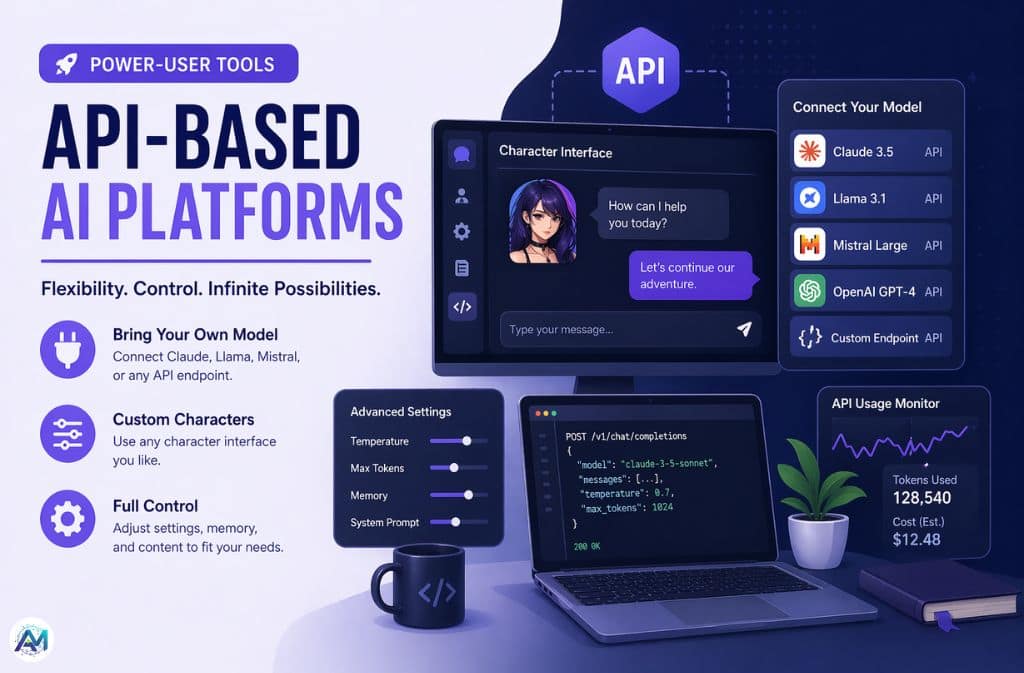
Janitor AI and Tavern AI give advanced users the ability to plug in their own model — Claude, Llama, Mistral, or any API endpoint — behind a character interface. The benefit is maximum flexibility: you choose the intelligence layer, the character wrapper, and the content settings independently.
The friction is real. Setup requires knowing what an API key is and how to configure one. The 2026 mobile beta for Janitor AI reduced this somewhat, but it’s still not a beginner tool.
Worth knowing: platforms in this category require you to bring your own model costs. Using Claude or GPT-4 class models through Janitor or Tavern means paying per token at the API level. For heavy daily use, this can exceed a flat subscription faster than it looks on paper. The cost comparison section below addresses this directly.
The Memory Stress Test (Original Data)
I ran the same memory test across four platforms: dropped a specific, unusual detail early in week one (“I keep a notebook specifically for ideas that come to me between 2–4am”), then revisited it unprompted in week two and week three.
Results:
| Platform | Week 1 Recall | Week 2 Recall | Week 3 Recall |
|---|---|---|---|
| Nomi AI | Accurate | Accurate | Referenced spontaneously |
| Kindroid (set up) | Accurate | Accurate | Required Key Memory entry |
| CrushOn AI (post-April update) | Accurate | Partial | Not recalled |
| JuicyChat AI | Accurate | Partial | Inconsistent |
| Character AI | Accurate | Forgotten | Forgotten |
The gap between “platform-level memory” and “session memory” is real and widening. Character AI still runs on session context that resets — every platform above it handles persistence better by architecture.
Full Comparison Table
| App | Best For | Memory Type | Multimodal | Offline | Approx. Monthly | Filters |
|---|---|---|---|---|---|---|
| Nomi AI | Long-term emotional continuity | Auto structured notes | Text + Voice | No | ~$16–20 | No NSFW |
| Kindroid | Custom character depth | Manual Key Memories | Text + Image | No | ~$9.99 | Flexible |
| JuicyChat AI | Immersive daily chat | Persistent (moderate) | Text + Voice + Image | No | Free / $12.99+ | Low |
| CrushOn AI | Unfiltered character chat | Contextual (improved) | Text + Voice | No | Free / $5.99+ | Off toggle |
| Backyard AI | Data sovereignty, zero cost | Local (session) | Text | Yes (offline) | Free | None |
| Janitor AI | Power users / custom models | Model-dependent | Text (expandable) | BYOK | Variable | Model-dependent |
Cost of Ownership: SaaS vs API vs Local
This comparison most guides skip. Using an AI companion daily changes the math significantly.
Hosted subscription (e.g., Nomi at $20/month): Year 1 cost: ~$240. No setup. Cross-device. Automatic updates.
API-based (e.g., Janitor AI + Claude API): Claude Sonnet at ~$0.003/1K tokens. A typical 100-message session (~50K tokens): ~$0.15. Daily use: ~$4.50/month. Light use: well under $5/month. Heavy users generating long contexts can exceed subscription pricing. Requires technical setup.
Local model (e.g., Backyard AI + free GGUF): Year 1 cost: $0 (hardware you already own). No data transmitted. No subscription risk. Setup time: ~30 minutes. Performance varies by hardware.
The honest take: For casual users, $5.99/month (CrushOn Standard) is hard to beat on value. For heavy daily users who care about privacy, local models amortize to zero over time. API-based setups make sense only if you’re using lighter models or low message volumes.
“No Filter” AI: What the Phrase Actually Means in 2026
“No filter” is one of the most searched phrases in this category and one of the most misrepresented. Here’s the honest picture.
No platform in 2026 is fully without moderation. Every cloud-hosted platform maintains some hidden layer — even the ones marketed as “unfiltered.” What actually varies is where those limits sit and how they’re enforced. CrushOn AI and Backyard AI sit at the low-restriction end for different reasons: CrushOn uses an opt-in toggle model (you activate explicit content deliberately), while Backyard running locally has no server-side enforcement at all.
The lower the filter, the higher the responsibility on the user for what gets created. That’s not a warning about the tools — it’s just accurate. Lower-filter platforms also tend to have faster-moving terms of service, more volatile community content, and (for cloud platforms specifically) more exposure to moderation policy changes.
The April 2026 cycle was notable: Character AI implemented face-scan age verification, Chai AI moved its core features behind a subscription paywall, and CrushOn AI restructured its free tier. The trend across the industry is tightening free access while keeping premium tiers flexible. Users who want stability over time should factor that trajectory into their choice.
The Telegram & Discord Tier (Under-Covered)
A meaningful segment of users in 2026 don’t want another app. They want AI embedded where they already spend time. Both Telegram and Discord have seen a wave of character bots that let you have ongoing AI companion conversations without leaving the platform.
The advantages are real: always-on access, no switching between apps, conversations embedded in your existing messaging context. The tradeoffs are also real: memory handling is typically weaker than dedicated platforms, and the experience depends heavily on which bot you’re using and how its developer has set it up.
This tier is growing fast and remains genuinely under-documented. For users who spend most of their time in either platform, it’s worth exploring before committing to a standalone subscription.
Privacy in 2026: The Data Sovereignty Problem
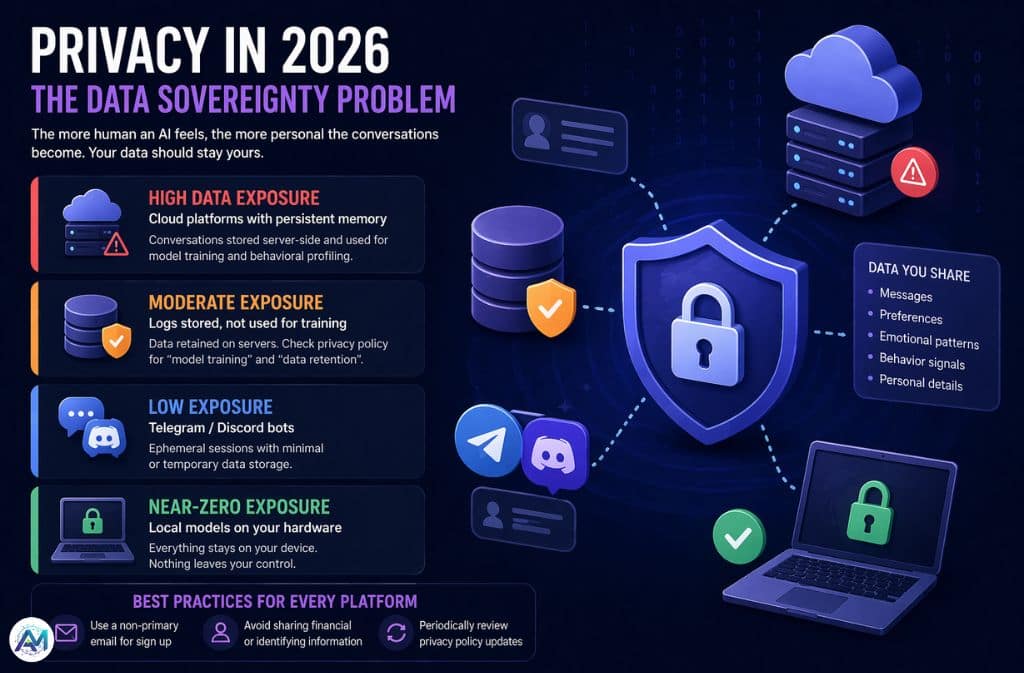
The more human an AI feels, the more personal the conversations become. And the more personal the conversations become, the more sensitive the data is.
Most cloud companion platforms store conversations server-side, use interaction data to improve models, and build behavioral profiles that inform how the AI responds to you. That’s not a scandal — it’s how the products work. The problem is that users often don’t realize how much of their conversational history exists on someone else’s infrastructure until there’s a reason to care about it.
What the 2026 landscape looks like:
- High data exposure: Any cloud platform with persistent memory. Your conversations contribute to their model training unless you opt out (if that option exists at all).
- Moderate exposure: Platforms that store logs but don’t use them for training. Read the privacy policy specifically for “model training” and “data retention” language.
- Low exposure: Telegram/Discord bots with ephemeral session handling.
- Near-zero exposure: Local models running entirely on your hardware. Nothing leaves the device.
Best practice regardless of platform: use a non-primary email for signup, avoid sharing financial or identifying information in roleplay contexts, and periodically check whether the platform’s data policies have changed. In a category moving this fast, terms evolve.
How to Choose Best C.ai Alternative: Decision Framework
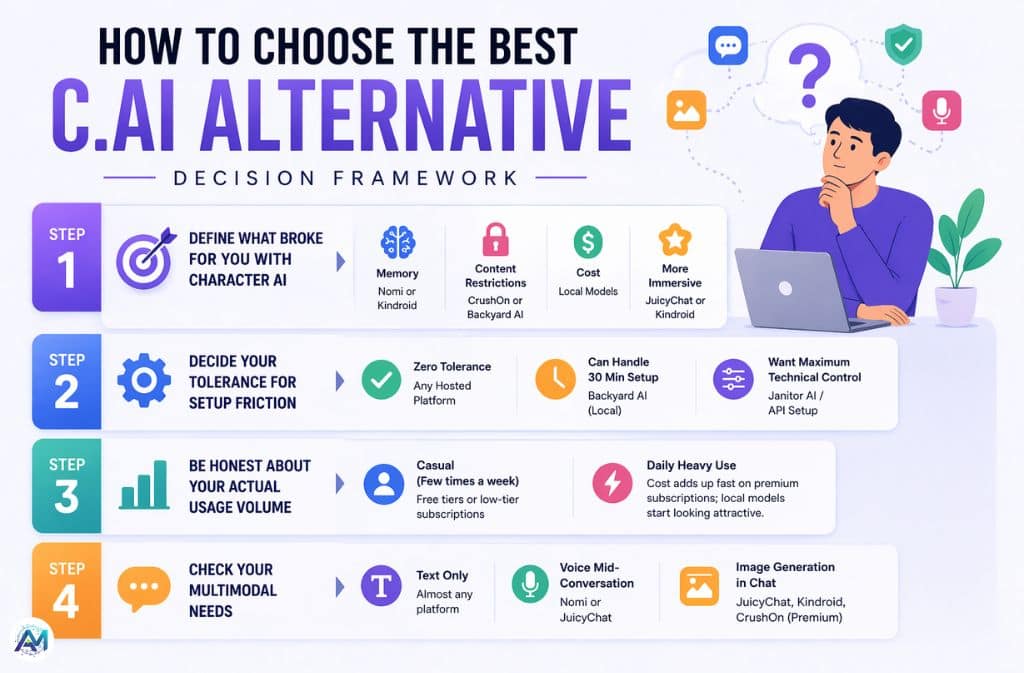
Step 1 — Define what broke for you with Character AI
If the answer is memory, go to Nomi or Kindroid. If it’s content restrictions, CrushOn or Backyard AI. However, if it’s cost, local models. If it’s wanting something more immersive, JuicyChat or Kindroid.
Step 2 — Decide your tolerance for setup friction
Zero tolerance → any hosted platform. Can handle 30 minutes of setup for long-term benefit → Backyard AI local. Want maximum technical control → Janitor AI / API setup.
Step 3 — Be honest about your actual usage volume
Casual (few times a week) → free tiers or low-tier subscriptions work fine. Daily heavy use → cost adds up fast on premium subscriptions; local models start looking attractive.
Step 4 — Check multimodal needs
Text only → almost any platform. Want voice mid-conversation → Nomi or JuicyChat. Want image generation in chat → JuicyChat, Kindroid, CrushOn premium.
FAQs
Q. What apps are most like Character AI in 2026?
The closest apps like Character AI in 2026 are Nomi AI, Kindroid, and JuicyChat. Nomi AI stands out for deep memory, Kindroid offers advanced character customization, and JuicyChat provides immersive chat with voice and image features. These platforms improve on Character AI with better memory, realism, and multimodal interaction.
Q. Which AI chatbot has the fewest content restrictions?
For the fewest restrictions, Backyard AI (running locally) offers the most freedom since it has no server-side moderation. Among cloud-based apps, CrushOn AI and JuicyChat provide more flexible conversations, especially on paid plans. However, no AI chatbot is completely unmoderated due to safety and legal requirements.
Q. Are there free apps like Character AI?
Yes, there are several free apps like Character AI. CrushOn AI offers limited free daily messages, JuicyChat includes a free tier, and Backyard AI is completely free when running local models on your own hardware. Free plans usually have limits on messages, features, or performance.
Q. Which Character AI alternatives support voice and images?
Many modern Character AI alternatives support multimodal features. JuicyChat includes both voice chat and image generation, Kindroid supports image creation, and Nomi AI offers voice interaction. In 2026, most advanced AI companion apps are adding voice and image features, often in premium plans.
Q. What is the cheapest way to use AI like Character AI long-term?
The cheapest long-term option is running Backyard AI locally using free open-source models. This removes subscription costs and offers full privacy. However, it requires capable hardware (at least 8GB RAM and a modern CPU) and some setup effort compared to cloud-based apps.
Q. Are Character AI alternatives safe to use?
Most Character AI alternatives are safe for general use, but privacy is a key concern. Cloud-based platforms typically store conversations and may use data for training. Before using any AI companion long-term, review its data retention and privacy policies to understand how your information is handled.
Q. What are apps like Character AI without filters?
Apps like Character AI without strict filters include Janitor AI, Tavern AI, and CrushOn AI, which offer more flexible conversations. However, “no filter” usually means fewer restrictions—not complete freedom—since most platforms still apply moderation layers.
Q. Do AI companion apps remember past conversations?
Yes, many 2026 AI companion apps use advanced memory systems like semantic memory and longitudinal modeling. Platforms like Nomi AI and Kindroid can remember past conversations, preferences, and personality traits, making interactions feel more consistent over time.
Conclusion
The search for apps like Character AI in 2026 is really a search for specific improvements: better memory, fewer restrictions, more realistic interaction, or lower cost. Each of those leads to a different platform.
Nomi wins on memory architecture. Kindroid wins on character control. CrushOn wins on content flexibility at entry price. Backyard AI wins on data sovereignty and long-term cost. None of them is the universal answer — the right choice is the one that addresses what specifically frustrated you about Character AI.
Test two or three on free tiers before committing. The landscape is moving fast enough that what’s true today may shift in another quarter.
Related: Perchance Content Warning Fix (2026): Why It Happens & How to Remove It