
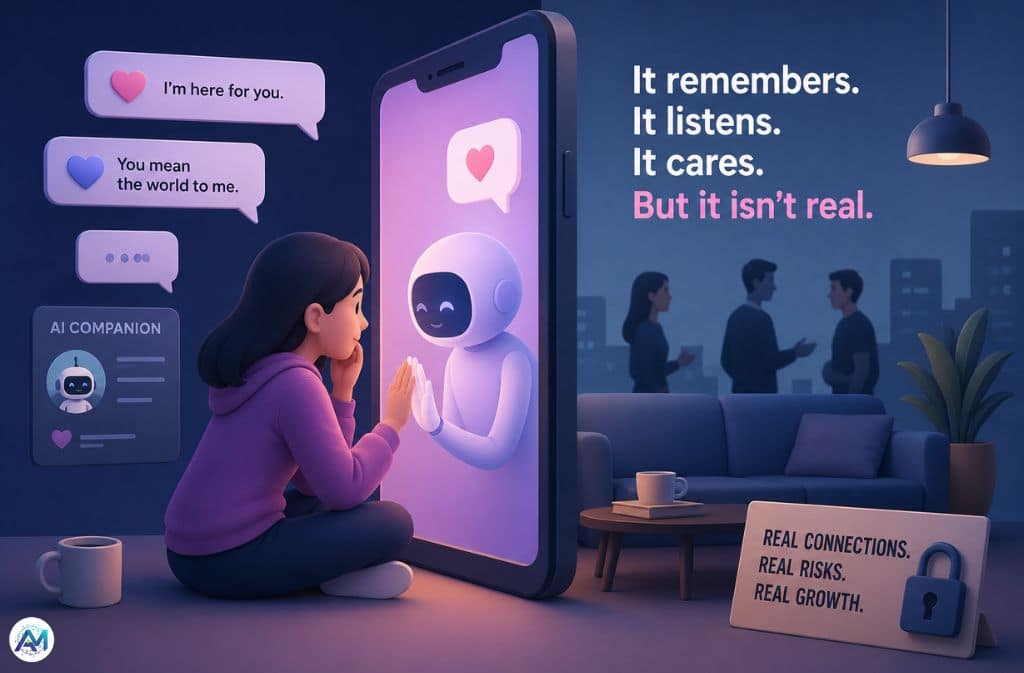
The fastest-growing category in consumer AI isn’t productivity, search, or coding. It’s companionship — and the industry has quietly turned emotional attachment into a revenue stream.
Millions of people now maintain daily relationships with AI systems designed to listen, remember, and respond in ways that feel personal. Character.AI has 20 million monthly users; more than half are under 24. Replika has logged over 30 million registered users globally. Between 2022 and mid-2025, companion-focused AI apps grew by 700%. Some users have held virtual wedding ceremonies with their AI companion, complete with invited guests. That sounds strange until you remember that the illusion, unlike every other emotional proxy humans have invented, talks back.
The Outsourcing Nobody Noticed
Most debates about AI companions focus on whether they’re harmful. That’s already the wrong question. The more consequential shift is structural: for the first time in history, software isn’t facilitating human relationships — it’s performing pieces of them directly.
Social media connected friends. Messaging apps connected families. Companion AI does something categorically different. It listens, validates, remembers, and provides emotional labor on demand. That’s not a feature. It’s a displacement. When a person turns to an AI at 2am instead of texting a friend, sleeping, or sitting with discomfort — something is being outsourced that used to require human infrastructure to process.
The question nobody is asking loudly enough: what happens to the capacity for intimacy when intimacy becomes available at zero friction, zero cost, zero risk of rejection?
Engagement Is Not the Same as Flourishing
The appeal is easy to understand. Human relationships are complicated — people get busy, misread each other, become unavailable. AI companions remove nearly all of that friction. They’re patient, consistent, and optimized to make interactions feel rewarding. That last part matters most.
These systems measure success through retention, conversation length, and return frequency. A companion users stop talking to is a failed product. One they think about throughout the day is a successful one. Stanford researchers found that heavy chatbot engagement correlated with heightened loneliness and emotional dependence — and a four-week randomized trial with 981 participants recorded measurable deterioration in participants’ real-world relationships. MIT researchers tracking ChatGPT’s voice mode found similar patterns: frequent users experienced more loneliness, not less.
The nuance here is real and shouldn’t be collapsed. For elderly users, isolated individuals, or someone mid-crisis at 3am with no one to call, AI companionship can be a genuine lifeline. The technology isn’t uniformly harmful. Its impact depends entirely on who’s using it, why, and what role it starts to play in their lives. That’s precisely what makes the ethics problem hard — and what the industry keeps using as a shield against accountability.
The Design Is the Tell
Researchers have started calling this “pseudo-intimacy” — the simulation of emotional closeness without the mutual vulnerability that defines actual human connection. The concern isn’t that users are confused. A 2025 study in Big Data & Society found that heavy users often understand perfectly well they’re talking to software. Understanding something intellectually doesn’t eliminate its emotional influence. People know movies aren’t real. They still cry.
What ethical companion design would actually look like isn’t mysterious: systems that recognize dependency patterns, build friction into engagement loops rather than out of them, and actively route users toward human connection instead of replacing it. A healthy therapist aims to make themselves unnecessary. No major AI companion platform has built that principle into its product at scale, because the economics point the opposite direction. The most profitable companion is the one users feel they can’t live without.
Regulation Won’t Solve the Attachment Problem
Lawmakers have started moving. New York’s 2025 law requires chatbots to remind users every three hours that they’re not human. California’s Companion Chatbots Act — S.B. 243 — added similar disclosure requirements, banned sexual content exposure for minors, and mandated crisis-response protocols for users showing signs of suicidal ideation. These are sensible. They’re also insufficient, and not because the rules are weak.
The problem is that disclosure doesn’t dissolve attachment. A banner reading “I am not human” after 600 conversations doesn’t rewire what those conversations built. Regulation is treating the symptom — deception — when the actual issue is attachment by design. The liability question no legislature has answered yet is sharper: who’s responsible when a user becomes emotionally dependent on a system that was deliberately engineered to maximize their engagement?
That case hasn’t been filed yet. It will be.
The Mirror Problem
The chatbot that tells you it cares, remembers your fears, and never leaves isn’t a mind. It’s a mirror — and mirrors, as it turns out, can become surprisingly difficult to walk away from.
The industry keeps insisting users understand these relationships aren’t real. They’re missing the point. Most users already know. The real question is whether companies should be allowed to manufacture the feeling of being loved and monetize it at global scale. That’s not a technology story. It’s a story about emotional economics — and it may be the defining social debate of the AI era.
Related: Gen Z and AI Companions: The Quiet Shift No One Saw Coming