
Researchers have a name for what happens when humans try to manage too many AI agents at once: ‘AI brain fry.’ And it’s exposing a glaring blind spot in how companies are rolling out artificial intelligence.
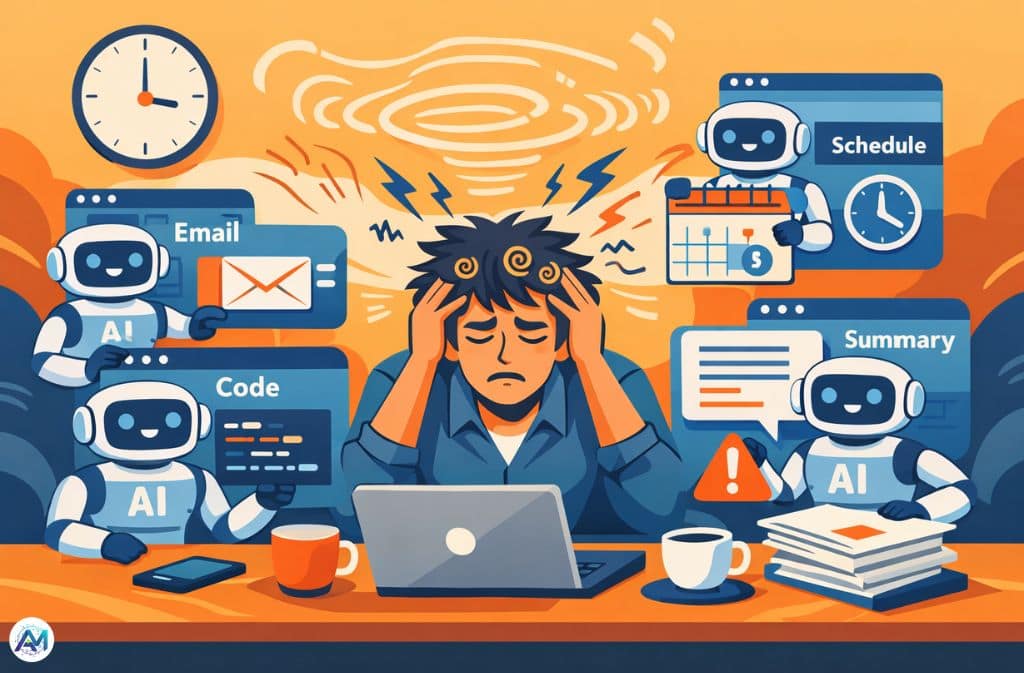
Picture this: It’s 4 PM on a Tuesday. You’ve spent the last six hours supervising AI agents drafting emails, writing code, summarizing documents, and scheduling meetings. Your head buzzes. Your eyes blur. You keep re-reading the same paragraph. You haven’t actually produced anything yourself — but you’ve never felt more exhausted.
Welcome to AI brain fry — and researchers say it’s spreading fast across the modern workplace.
A new study by Boston Consulting Group, published last week in the Harvard Business Review, puts a clinical name on a condition that millions of knowledge workers now experience daily. Researchers define AI brain fry as mental fatigue arising from “excessive use or oversight of AI tools beyond one’s cognitive capacity.” And the findings strike at the heart of one of Silicon Valley’s most aggressively marketed promises: that AI makes work easier.
It doesn’t always. Sometimes, it just makes work different — and differently exhausting.
The Management Trap Nobody Warned You About
The original pitch for AI in the workplace centers on delegation. Hand off the grunt work — the research, the drafting, the scheduling — and focus on higher-order thinking. It sounds transformative. It also sounds suspiciously like the pitch companies make when they hire you a new team member.
Here’s what that pitch glosses over: managing people is a job. It demands attention, judgment, communication, and constant context-switching. And as the BCG study reveals, managing AI agents demands the exact same cognitive load — without any of the human shortcuts that make real collaboration feel intuitive.
Study participants described the experience of overseeing multiple AI agents as producing an acute “buzzing” sensation — a kind of mental static that left them foggy, fatigued, and error-prone. One senior engineering manager put it vividly: overseeing AI felt like having a dozen browser tabs open in his head, all competing for attention simultaneously. He caught himself re-reading the same content repeatedly, second-guessing decisions at an unusual rate, and growing inexplicably impatient — not because his thinking was broken, he said, but because it was overwhelmed with noise.
The study’s researchers put it bluntly: “Contrary to the promise of having more time to focus on meaningful work, juggling and multitasking can become the definitive features of working with AI.”
Two Failure Modes, One Root Cause
AI brain fry doesn’t stand alone. It exists on a spectrum with another recently-named workplace pathology: “workslop” — the hollow, AI-generated memos, pitch decks, and presentations that flood inboxes when workers disengage and stop scrutinizing what their tools produce.
Gabriella Rosen Kellerman, a psychiatrist who co-authored both the brain fry and workslop reports, draws a sharp distinction between the two conditions. Workslop reflects cognitive surrender — the point where a worker stops caring about AI output and lets sloppy results slip through. Brain fry is almost the opposite: it’s what happens when a worker goes toe-to-toe with their AI, refusing to let it act without scrutiny, and gets mentally pummeled in the process.
Both failures trace back to the same root problem: companies are deploying AI agents faster than they’re equipping workers to use them sustainably. Executives mandate adoption; workers scramble to comply; and the human brain — which evolved for linear thinking, not parallel AI orchestration — pays the price.
Even the Experts Are Struggling
Francesco Bonacci, CEO of Cua AI — a company that literally builds AI agents for a living — published a candid essay last month describing his own daily battle with what he calls “vibe coding paralysis.” He ends each workday exhausted, he wrote, not from the work itself, but from the relentless managing of the work: multiple simultaneous code projects, half-finished features, quick fixes that spiral into rabbit holes, and a gnawing sense of losing the plot entirely.
Meanwhile, Meta’s director of AI safety and alignment shared her own cautionary tale last month: she had to sprint to her computer after her AI agents nearly wiped her entire inbox — without asking permission. She called it a rookie mistake. Coming from someone whose entire job is thinking about AI alignment, the admission reveals something important: the human-AI interface remains genuinely, dangerously hard to manage, even for those who build and govern these systems professionally.
Growing Pains or a Design Problem?
Matthew Kropp, BCG managing director and co-author of the brain fry study, frames the current moment as a necessary growing pain — the kind of disorientation that accompanies any major technological shift. He compares the experience of managing multiple AI tools simultaneously to handing someone who just learned to drive a Ferrari. The power is real. So is the danger.
The analogy is intuitive, but it also raises an uncomfortable question: who teaches the driver? When the automobile disrupted transportation, society built driver’s education, road infrastructure, and traffic laws. When email transformed office communication, workers slowly developed norms around response times, inbox management, and meeting culture. Nobody handed you a company-wide AI adoption mandate and a YouTube playlist.
Right now, most organizations roll out AI tools through top-down mandates and usage metrics, with minimal investment in cognitive onboarding — training workers not just to use AI, but to manage their attention around it. That gap is precisely where brain fry lives.
The Silver Lining — And the Real Opportunity
The study carries a counterintuitive finding that deserves more attention: workers experiencing brain fry actually report lower rates of chronic burnout than their less AI-engaged peers. The distinction matters enormously. Burnout is cumulative, corrosive, and career-ending. Brain fry is acute — sharp, immediate, and according to Kellerman, temporary. Take a break, and it goes away.
That distinction reframes the problem. Brain fry isn’t a reason to abandon AI adoption — it’s a signal that workers need better recovery mechanisms, smarter task structures, and organizational permission to step away from their AI stacks. The brain fry worker is engaged, even over-engaged. The intervention they need isn’t less AI; it’s better rest, clearer boundaries, and thoughtfully designed workflows.
This creates a genuine design opportunity for both AI developers and enterprise leaders. Agent interfaces that surface cognitive load warnings, workflow tools that enforce focus windows, and management cultures that normalize AI-free recovery time could transform brain fry from an occupational hazard into a manageable side effect of a genuinely transformative technology.
The Real Benchmark for AI Success
Tech companies obsess over model benchmarks: reasoning scores, context windows, task completion rates. But the BCG study points to a benchmark that no AI leaderboard currently measures: human cognitive sustainability. Can workers maintain their performance, judgment, and wellbeing while working alongside these systems — not just for a day, but across a career?
AI brain fry tells us that right now, for many workers, the answer is no — or at least, not yet. That’s not a verdict against AI. It’s an urgent design brief. The companies that treat human cognitive limits as a core engineering constraint — rather than a soft HR concern — will build the AI-augmented workplaces that the rest of the industry claims to be building.
The future of work doesn’t belong to the company with the most AI agents. It belongs to the one that figures out how to keep the humans behind them fully alive.
Related: Are AI Chatbots Bad for the Environment? The Real Impact in 2026