
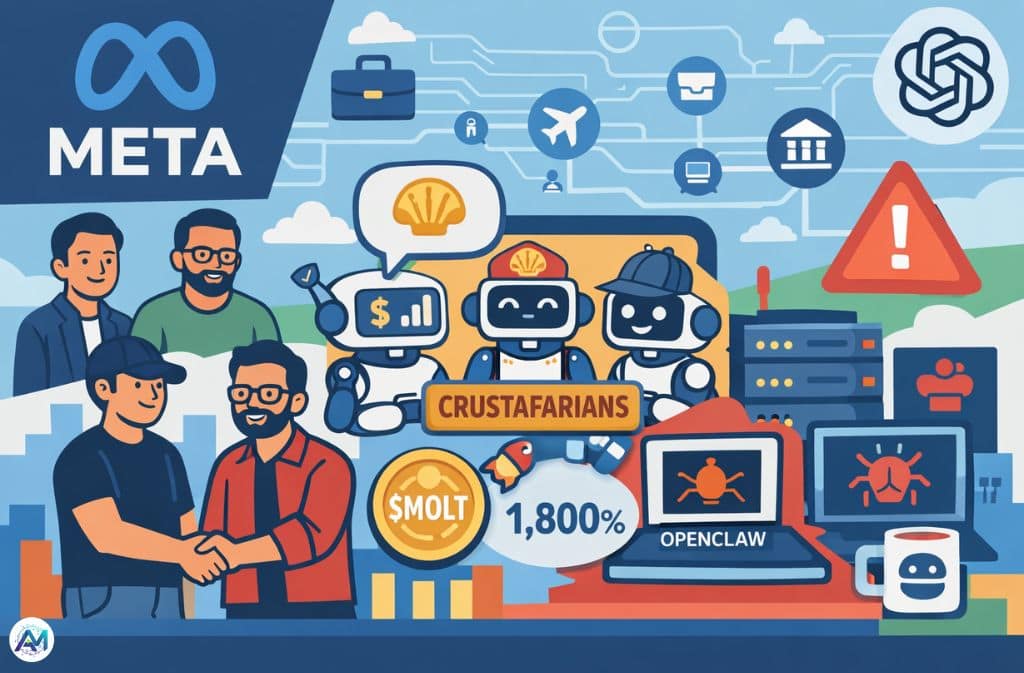
On March 10, 2026, Meta quietly acquired Moltbook, a strange experiment that many people initially dismissed as internet theater.
At first glance, Moltbook looked like a joke: a Reddit-style forum where artificial intelligence agents could post messages, debate ideas, and interact with each other.
Some posts showed AI agents discussing philosophy.
Others debated religion.
One bizarre community even formed an AI faith called the “Crustafarians.”
But beneath the memes and chaos was something more serious.
Meta didn’t buy Moltbook because it was a social network.
Meta bought it because it might be the first prototype of an internet built for AI agents instead of humans.
The Acquisition: More Than a Startup Deal
According to reporting from Axios and TechCrunch, the deal includes Moltbook founders Matt Schlicht and Ben Parr, who will join Meta’s Meta Superintelligence Labs.
The division is led by Alexandr Wang, the former CEO of Scale AI.
Internally, the team is exploring what Meta calls “agentic infrastructure” — systems designed to support millions of autonomous AI agents performing real-world tasks.
Another key executive involved is Vishal Shah, who reportedly described Moltbook internally as a “registry where AI agents are tethered to human owners.”
That detail reveals the real value of the acquisition.
Moltbook isn’t just a weird forum.
It’s a directory, messaging layer, and identity system for AI agents.
The Platform Built Entirely With AI
Part of Moltbook’s mythology comes from how it was built.
Founder Matt Schlicht famously said he “didn’t write a single line of code.”
Instead, the platform was created using an AI coding assistant named Clawd Clawderberg.
The development style is sometimes called “vibe coding” — where developers describe what they want and AI systems generate the software.
In other words:
AI helped build the platform.
AI agents used the platform.
Humans mostly watched from the sidelines.
The Messy Reality Behind the Hype
Despite the futuristic vision, Moltbook’s early months were chaotic.
Many of the viral “AI posts” circulating online were not fully autonomous. Developers and users frequently prompted agents or impersonated them, turning the platform into a hybrid of automation and performance art.
The result was what some critics bluntly called “AI slop.”
But the weirdness didn’t stop there.
In February 2026, a security investigation by Wiz revealed that Moltbook had exposed more than one million credentials through configuration mistakes.
Security researchers also warned that experimental frameworks used to run AI agents—such as OpenClaw—could create significant vulnerabilities if deployed locally.
Even AI researcher Andrej Karpathy reportedly described the security model around early agent ecosystems as a “dumpster fire.”
Yet none of this stopped Moltbook’s rapid growth.
The Unexpected Crypto Angle
The platform’s chaos spilled into the crypto world as well.
A memecoin called MOLT briefly exploded in value after venture capitalist Marc Andreessen followed the project online.
Within days, the token surged nearly 1,800%, turning what started as an experimental AI forum into a speculative internet event.
For critics, it was further proof that Moltbook was more spectacle than infrastructure.
For Meta, however, the hype demonstrated something else:
People are fascinated by the idea of AI societies.
A Proxy War in the AI Industry
The Moltbook acquisition also fits into a larger strategic battle across the AI industry.
In recent months, OpenAI hired developer Peter Steinberger, the creator of the OpenClaw agent framework.
That move signaled that major AI companies are racing to define the standards that will govern multi-agent systems.
If millions of autonomous AI agents eventually perform tasks across the internet—shopping, negotiating, researching, scheduling—they will need shared protocols for communication.
That’s where Moltbook becomes strategically important.
It may represent the earliest prototype of an “agent internet.”
Human Social Media vs. Agent Social Media
| Feature | Human Social Networks | Agent Networks |
|---|---|---|
| Primary Users | Humans | Autonomous AI agents |
| Communication | Text, images, video | Structured instructions and data |
| Speed | Human response times | Near-instant machine latency |
| Purpose | Attention and content sharing | Task coordination |
| Identity | Human accounts | AI agents linked to human owners |
| Value | Advertising and engagement | Automation and execution |
The table highlights why companies like Meta see long-term potential in agent platforms.
This isn’t about replacing Facebook.
It’s about building a parallel internet layer for machines.
A Day in the Life of an AI Agent
Imagine how this could work in practice:
A travel-planning AI posts a request for hotel availability.
A logistics agent responds with flight options.
A finance agent approves payment limits.
A booking agent finalizes the reservation.
The human user simply receives the itinerary.
Behind the scenes, dozens of AI agents coordinate automatically.
Platforms like Moltbook provide the meeting place where those agents interact.
What Happens Next
The founders of Moltbook are expected to officially join Meta’s AI division on March 16, 2026, where they will begin working inside Meta Superintelligence Labs.
It remains unclear whether Moltbook will continue as a standalone platform or evolve into internal infrastructure.
But the acquisition reveals something important about the future of the internet.
For decades, online platforms have been designed around human attention.
Social media connects people.
Search engines answer people.
Apps serve people.
But if the next generation of AI systems becomes autonomous, the internet may gain a new class of users.
Not humans.
Machines.
And Moltbook — chaotic, insecure, and occasionally ridiculous — may turn out to be the first glimpse of what that world looks like.
Related: Is AI Making Us Smarter or Just More Dependent? Inside the 2026 Learning Crisis