
AI doesn’t replace learning. It removes friction from it.
Used well, AI acts like an infinitely patient tutor. It explains a concept in different ways and quizzes you until you actually understand it. You can also turn a chapter or tutorial into practice material in minutes.
Used badly, it just hands you answers. You finish feeling like you learned something. You didn’t.
Research backs both outcomes. Studies on AI-assisted learning show real gains in personalization and engagement. A widely discussed MIT Media Lab study found the opposite: outsourcing your first attempt at a task to a chatbot can leave weaker memory traces than working through it yourself.
The gap comes down to how you use the tool. Not which tool you pick.
This guide gives you a system: a loop you can run on any subject, which tools do which job, how the method changes by skill, and where the real risks sit.
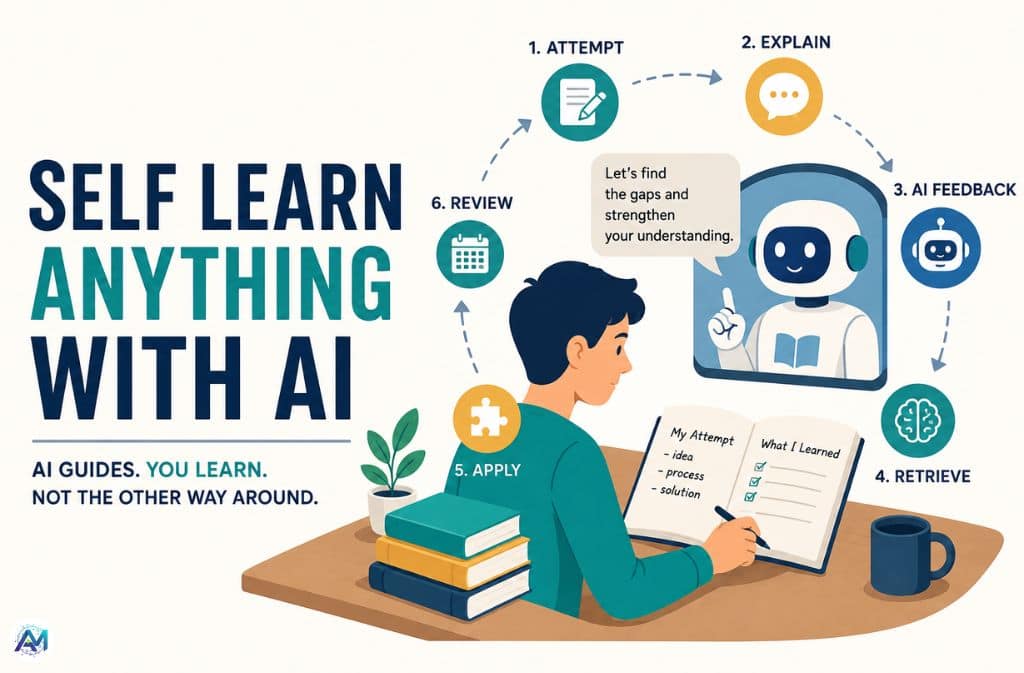
The AI Learning Loop
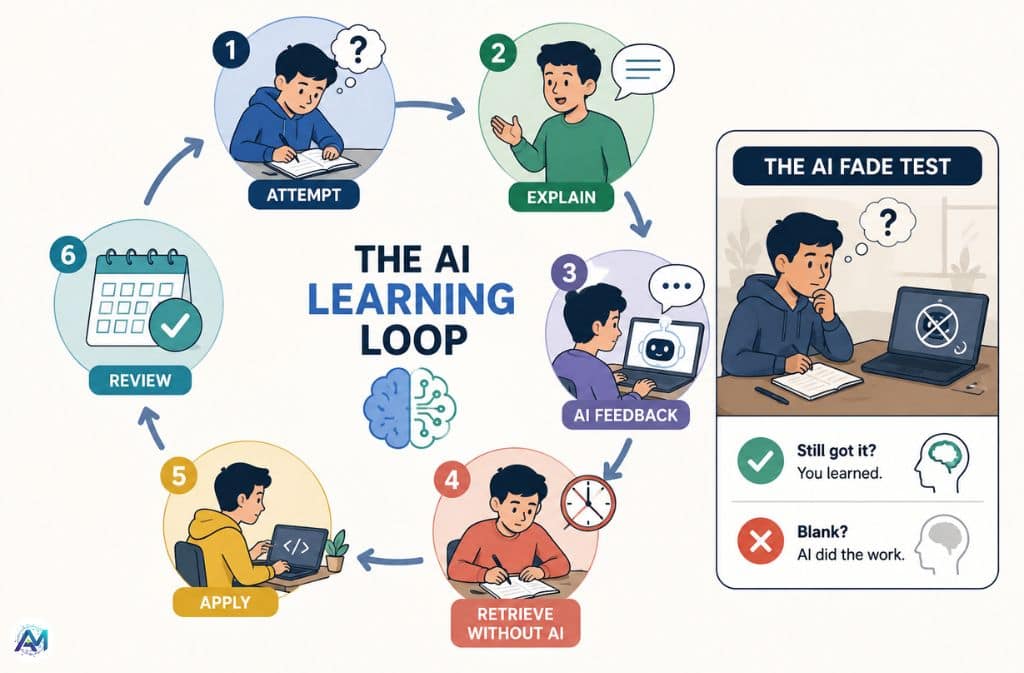
Six steps run through every section below:
- Attempt the problem, explanation, or exercise yourself first — even badly.
- Explain what you did or think, in your own words.
- Get AI feedback. Ask it to find gaps, errors, and missing links in your attempt. Don’t ask it to redo the work.
- Retrieve without AI. Quiz yourself or solve a fresh problem with no assistant open.
- Apply the skill somewhere real: a project, a conversation, a piece of writing, working code.
- Review on a schedule so the material doesn’t decay. Then repeat the loop on the next chunk.
Run it in this order and AI becomes an accelerant.
Skip straight to step 3 — asking AI to explain things you haven’t tried yourself — and you get the shallow-learning pattern the research below warns about.
One distinction matters here: feedback isn’t retrieval. AI telling you your answer is correct isn’t the same as being able to produce that answer again without help. Step 4 has to happen with no assistant open, every time.
Struggle before you consult. That’s the single habit this entire guide builds around.
The AI Fade Test
Close the chatbot. Try the task again from scratch.
Can you still explain it, solve it, or write it? AI probably helped you learn.
Did the skill disappear along with the chat window? AI probably did the work for you.
Run this test on anything you’re not sure about.
Which AI Tool Should You Use?
No single tool covers every part of self-learning. Pair a source-grounded tool for your own material with a Socratic tutor for practice. Add a spaced-repetition app for memorization.
| Job | Best fit | Why |
|---|---|---|
| Learn from your own notes, PDFs, or lectures | Gemini Notebook (formerly NotebookLM) | Built around source-grounded research and learning, with answers tied back to the material in your notebook |
| Socratic-style concept practice | ChatGPT Study Mode | Asks questions and checks understanding instead of answering outright |
| Structured K-12/intro tutoring | Khanmigo | Withholds direct answers and guides with questions |
| Durable memorization | Anki or Quizlet | Built for spaced-repetition scheduling and long-term recall, not general conversation |
| Research requiring citations | Source-grounded research tools | Cuts the risk of confidently wrong facts, dates, or stats entering your notes |
| Dense reading and writing feedback | Claude or a similar long-context assistant | Handles long documents and critiques drafts you wrote first |
A naming note: Google renamed NotebookLM to Gemini Notebook in July 2026. Same product, same source-grounded approach, now tied more closely to the wider Gemini app.
Pick tools by function, not brand — products evolve fast, and a single tool can cover more than one job. What matters is that your workflow covers three functions: explanation, retrieval practice, and scheduled review. Don’t confuse having an explanation with having learned it.
How the Method Changes by Skill
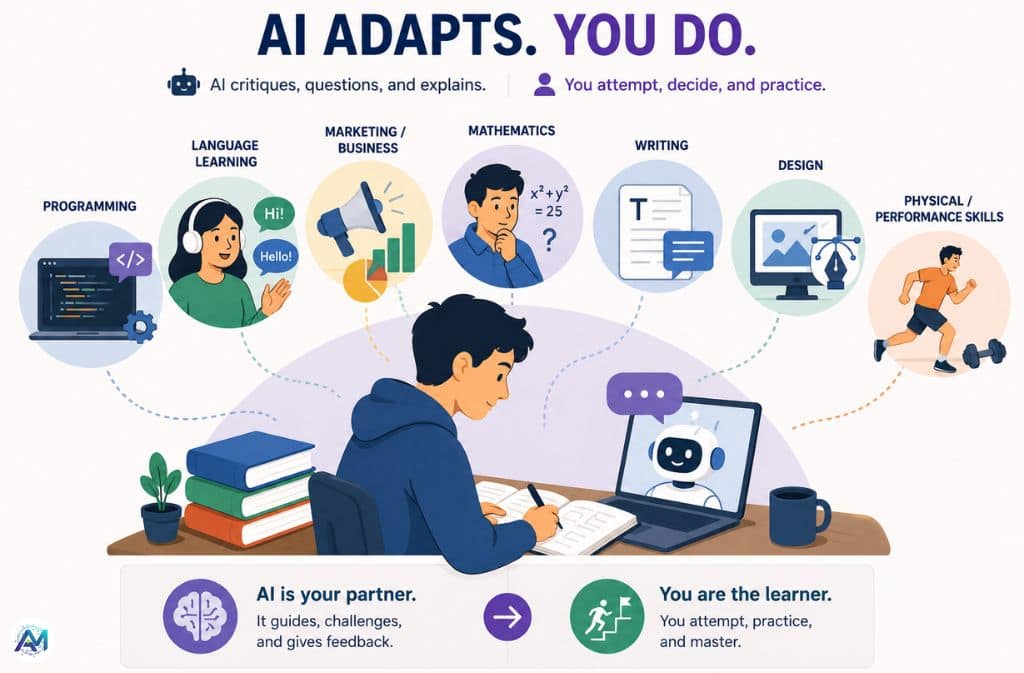
“Self-learn anything” only holds up if the system works outside a classroom.
AI’s best role shifts by subject. It’s a Socratic partner for math. A conversation partner for language. A critic — never the first draft — for anything creative or strategic.
| Skill | AI’s best role | Your job |
|---|---|---|
| Programming | Explain errors, generate exercises, review your code | Write and debug the first version yourself |
| Language learning | Conversation partner, correction, pronunciation feedback | Speak and retrieve vocabulary from memory |
| Marketing / business | Critique a plan, simulate a client or customer objection | Make the strategic calls with real data |
| Mathematics | Socratic problem-solving, step verification | Attempt the problem before seeing any hint |
| Writing | Critique structure, clarity, and argument in a draft | Write the first version without AI |
| Design | Give feedback and alternative directions | Create and evaluate the options yourself |
| Physical or performance skills (music, cooking, sport) | Explain technique, break steps into a practice sequence, describe what correct form should feel or look like | Practice the movement — AI can’t do the rep for you |
One pattern runs through every row: AI critiques, questions, and explains. You attempt, decide, and practice.
That division makes the method transferable instead of a study-only trick.
Programming breaks this pattern fastest if you let it. Research tracking how programming students actually use tools like ChatGPT found something specific: when students hit a hard exercise, most who opened the chatbot asked for a complete, working solution — not an explanation of what they got wrong. That finishes the assignment. It skips the skill the assignment was built to teach. If AI writes the whole function, you may end up with working code without having practiced the reasoning needed to write it yourself.
How to Structure a Self-Learning Plan
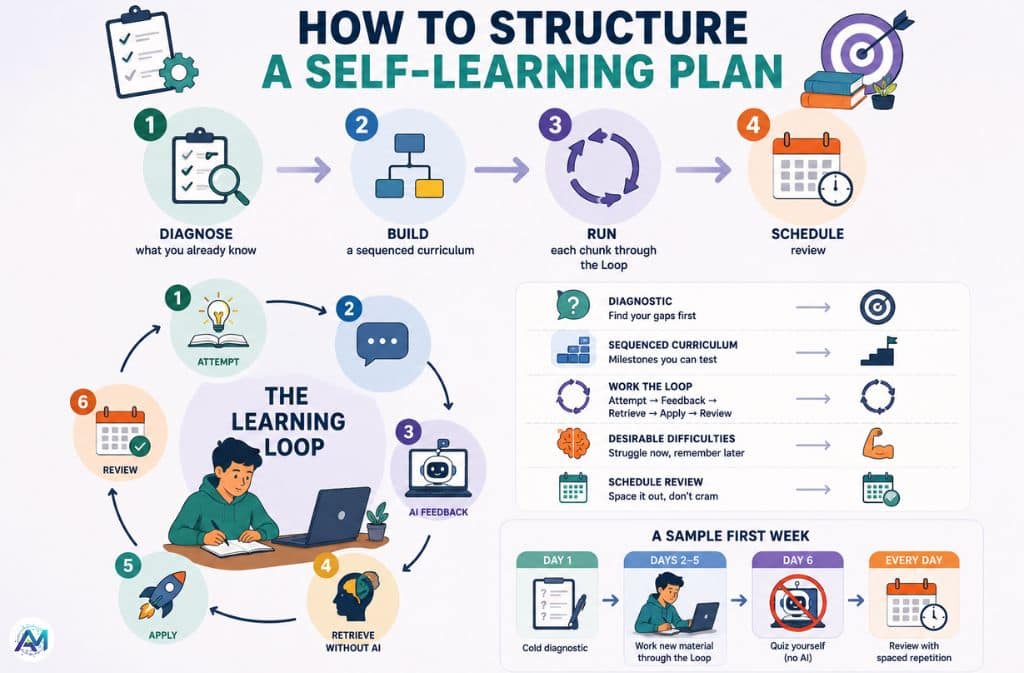
A working plan runs four stages before you ever open a chat window to “just ask”:
- Diagnose what you already know.
- Build a sequenced curriculum.
- Run each chunk through the Loop.
- Schedule review.
Skip the diagnostic and you’ll waste weeks re-learning material you already understood. That’s an easy way to lose momentum before you’ve really started.
Psychologist Robert Bjork coined the term “desirable difficulties” for learning conditions that feel harder in the moment but improve later retention. Testing yourself before you’re ready and spacing practice out instead of cramming are classic examples. AI can manufacture that difficulty on demand. Just don’t let it remove the difficulty instead.
Start with a real diagnostic
Ask AI to quiz you cold before you study anything. Use the gaps it finds to decide where to start.
Prompt (diagnostic): “Test me on [subject] without teaching me first. Ask one question at a time and identify exactly where my knowledge breaks down.”
Ask for a sequenced curriculum, not a reading list. Try: “I want to learn [subject] to [specific goal] in [timeframe]. I already know [X, Y]. Break this into weekly milestones, ordered from foundational to advanced, and tell me what I should be able to do by the end of each week.” Push back if a milestone feels vague. A good one gives you something you can test yourself against, not just a topic name.
Work each chunk through the Loop. Attempt first. Bring it to AI for feedback second.
Prompt (Feynman check): “I’ll explain [concept] in my own words. Identify inaccuracies, missing links, and misconceptions. Don’t rewrite it for me — just tell me what’s wrong or missing.”
When you’re stuck, don’t ask for the answer. Ask to be walked toward it.
Prompt (Socratic): “Don’t give me the answer. Ask me one question at a time until I can solve it myself. If I’m wrong, give me the smallest hint that moves me forward, not the solution.”
Practice with retrieval, not re-reading.
Prompt (exam simulation): “Create a test using only the material I’ve studied so far. Don’t reveal any answers until I’ve completed every question.”
Schedule review. Feed weak spots from your quizzes into a spaced-repetition tool. Review happens automatically over days and weeks instead of once, right before you move on and forget it.
A sample first week: Run the cold diagnostic on day one. Spend days two through five working new material through the Loop in small chunks. Use day six to close every tab and quiz yourself with no AI open. Push whatever you missed into a spaced-repetition deck. Review it daily going forward, even after week two starts.
The AI Learning Trap
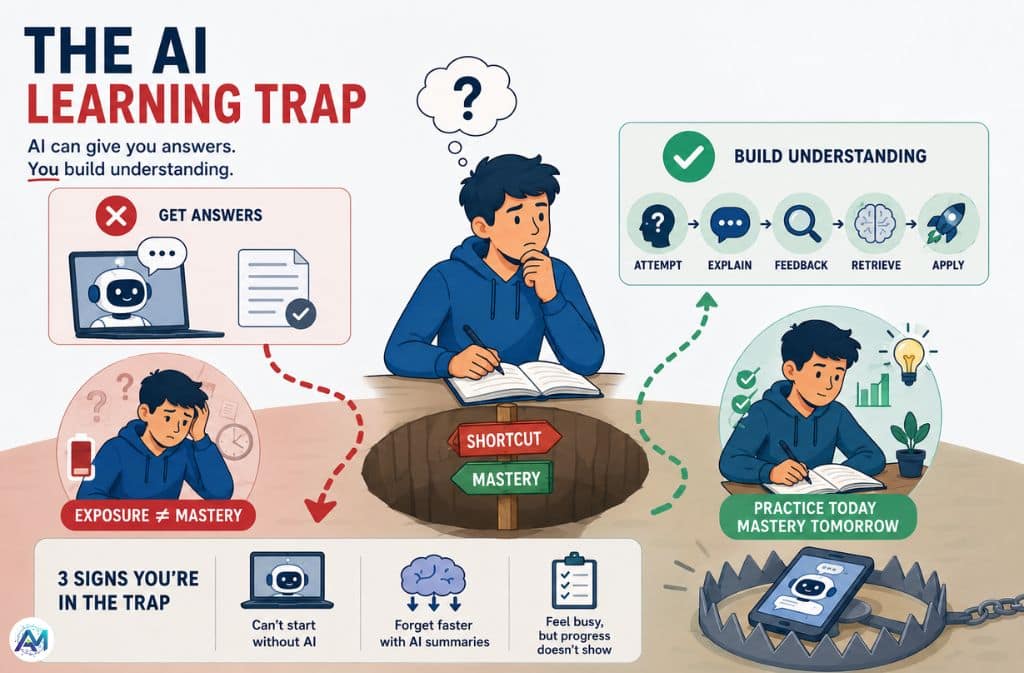
AI is exceptionally good at helping you produce something you don’t yet know how to produce yourself — a finished essay, a working script, a polished summary.
That’s genuinely useful at work.
It’s the wrong goal while you’re learning. If you want the essay, AI can hand it to you. If you want the ability to write that kind of essay yourself, the same shortcut removes the practice that builds it.
Ask this before every prompt:
| If you’re trying to… | AI can do more |
|---|---|
| Produce something (draft, summarize, format, translate, brainstorm) | Yes — let it |
| Learn something (attempt, recall, explain, solve, decide) | No — you do the work first |
The two look identical on the surface. They need opposite habits.
Because AI makes information so easy to reach, the real risk isn’t a lack of material. It’s mistaking exposure for mastery.
A fluent, well-organized AI explanation can feel like understanding. Nothing about that feeling would survive a closed-book test five minutes later.
The bad workflow: ask a question, read the answer, think “that makes sense,” move on. You retrieved nothing. You tested nothing. The feeling of clarity fades within a day.
The better workflow is the Loop: ask, attempt, explain, get challenged, retrieve, apply. It takes longer per topic. It covers less ground per hour. That’s exactly why it produces retention the fast version doesn’t.
Three signs you’ve fallen into the trap:
- You can’t start a task without opening a chatbot first.
- You forget material faster when AI summarizes it than when you work it out yourself.
- Your work feels polished but you couldn’t reproduce it closed-book.
Does AI Actually Weaken Your Memory?
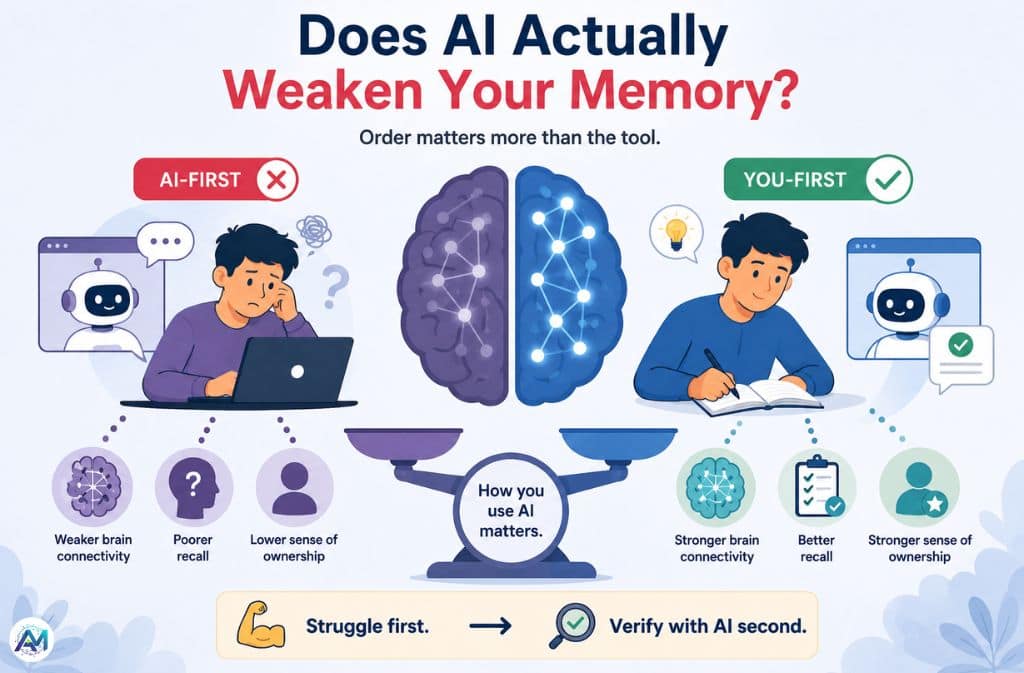
Sometimes. Specifically when you let AI generate the first version of your thinking, instead of checking or extending work you did yourself.
Researchers associated with the MIT Media Lab published a 2025 preprint — not yet peer-reviewed — that measured brain activity in 54 students. Each wrote essays with ChatGPT, with a search engine, or unaided. The AI-assisted group showed the weakest EEG connectivity, the poorest recall of their own writing, and the lowest sense of ownership over what they produced.
What the study shows:
- Differences in brain connectivity during the writing task across the three groups
- Weaker recall and sense of ownership among students who used AI first
- Effects tied specifically to AI-first essay writing, not AI use in general
What it doesn’t establish:
- That AI causes permanent brain damage or lasting cognitive decline
- That AI makes people less intelligent overall
- That every form of AI-assisted learning produces the same effect
- That the findings, drawn from essay writing, apply equally to programming, math, languages, or physical skills
One finding is especially relevant here: the order of AI use appeared to matter. Students who wrote first and used AI afterward showed patterns closer to the no-AI group than students who started with AI. But the study is small and specific to essay writing. It can’t establish that this ordering effect holds across every subject or over years.
That’s consistent with the rule this guide builds around: attempt first, AI second. Outside reviewers have also flagged that the study is short-term, and part of the effect may just reflect participants getting more practice at the task over repeated sessions — not AI-specific harm. Treat this as interesting preliminary evidence, not settled science.
Struggle first. Verify with AI second. That’s the practical rule.
How Much Should AI Actually Do?
AI should automate friction, not cognition.
It can reasonably handle formatting, quiz and flashcard generation, alternative explanations, feedback on a draft you already wrote, and scheduling review.
You keep the first attempts. The decisions. The recall. Applying the skill to something real.
You may have seen the “30% rule” online — a cap on how much of a piece of work should come directly from AI. It’s not an official standard from any research body or education authority. It’s an informal guideline, and no research-backed percentage tells you the right number.
Here’s a simpler check: if AI is doing most of the explaining, solving, and summarizing while you’re mostly copying and approving, you’ve drifted past the point where the tool helps you learn. The percentage doesn’t matter at that point.
What Are the Real Risks?
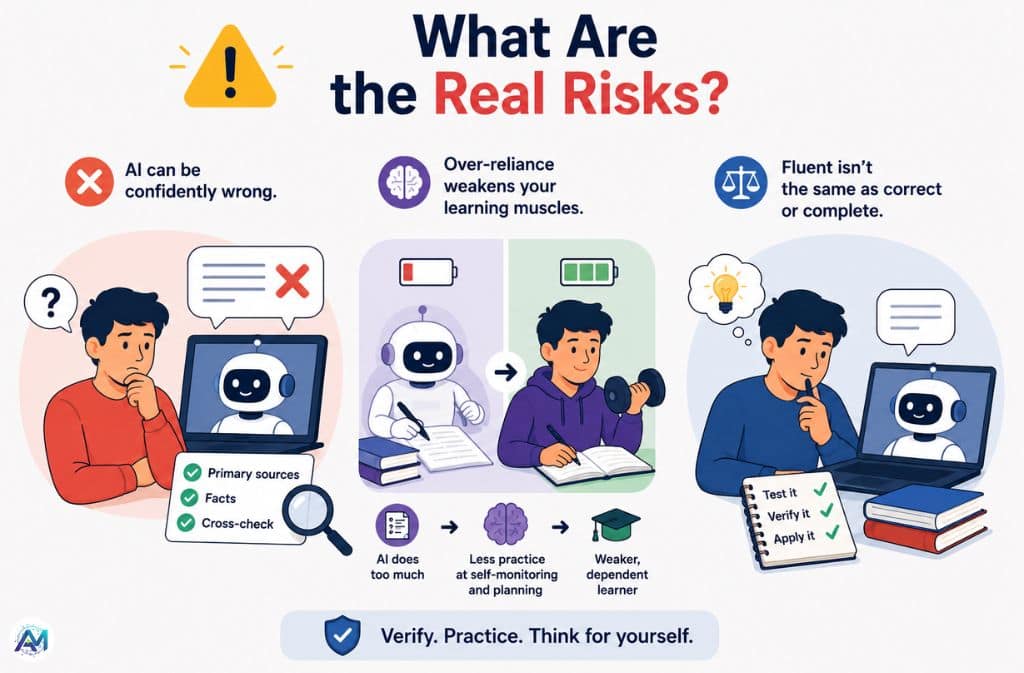
AI can be confidently wrong. This matters most with precise facts — dates, statistics, legal or medical details, exact formulas. Cross-check anything you’d be embarrassed to get wrong. Use a source-grounded tool or a primary source, not just a second chat with the same model.
The risk of over-reliance is real, and researchers are actively studying it. Researchers studying self-regulated learning have flagged a pattern: AI tools that do too much of the preparatory work — organizing material, generating summaries — leave students with less practice at planning and self-monitoring. Those are the skills that make someone a durable independent learner. Tools that make you retrieve, not just receive, avoid this trap better. For a broader look at how this plays out across classrooms, see this breakdown of the AI learning dependence pattern.
Fluent isn’t the same as correct or complete. Treat a first AI answer as a draft to test yourself against. Not a verdict.
AI Self-Learning vs. a Course vs. a Human Tutor
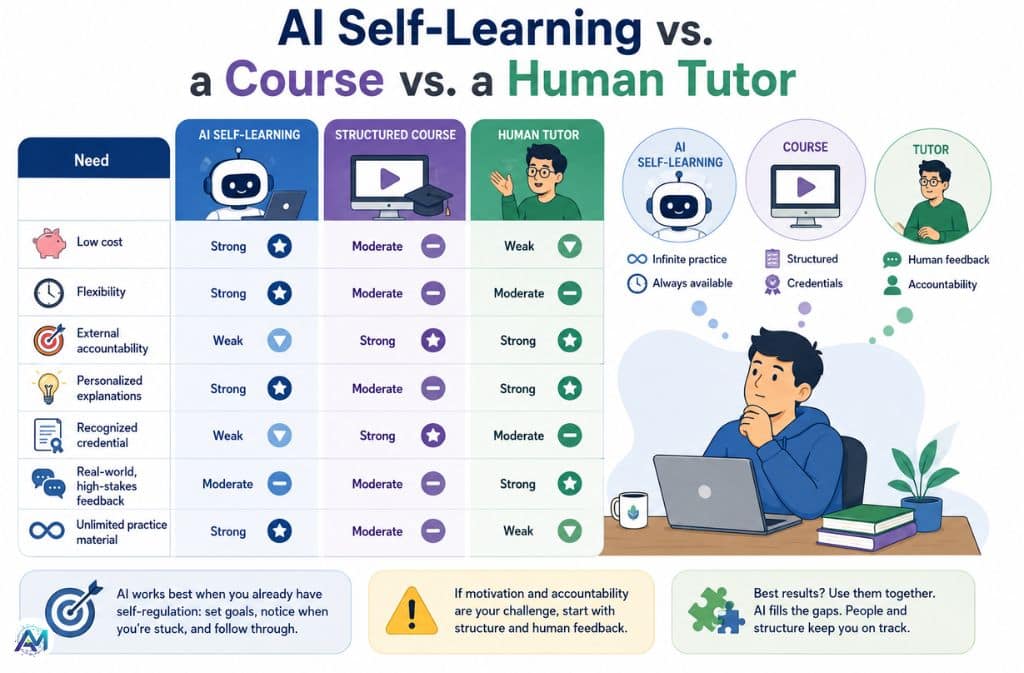
AI-assisted self-learning generally has advantages in cost, flexibility, and practice volume. Courses and tutors retain important advantages in accountability, credentials, and high-stakes feedback.
| Need | AI self-learning | Structured course | Human tutor |
|---|---|---|---|
| Low cost | Strong | Moderate | Weak |
| Flexibility | Strong | Moderate | Moderate |
| External accountability | Weak | Strong | Strong |
| Personalized explanations | Strong | Moderate | Strong |
| Recognized credential | Weak | Strong | Moderate |
| Real-world, high-stakes feedback | Moderate | Moderate | Strong |
| Unlimited practice material | Strong | Moderate | Weak |
AI is weakest exactly where motivation and accountability are the real bottleneck.
It works best for people who already have some self-regulation: the ability to set goals, notice when they’re stuck, and follow through without someone checking in.
If starting, staying consistent, or honestly judging your own progress is the hard part for you, an infinitely available chatbot won’t fix that alone. A structured course with deadlines and human feedback may get you further — at least until those habits are in place.
The two aren’t mutually exclusive. Plenty of learners run AI tools alongside a formal course to fill the gaps between lectures.
Frequently Asked Questions
Q. How can I use AI to learn by myself?
You can use AI to learn by yourself by treating it as a tutor rather than an answer generator. Start with the AI Learning Loop: attempt the task yourself, explain your reasoning, ask AI to identify gaps, retrieve the information without AI, apply what you learned, and review it later. This approach helps you use AI for feedback and practice without outsourcing the actual learning process.
Q. How do I learn AI itself as a beginner?
To learn AI as a beginner, start by getting hands-on with accessible AI tools, then follow one structured learning path and build a small project. You can experiment with tools such as ChatGPT, Claude, and Gemini Notebook before moving into more formal courses. Avoid jumping between multiple courses without completing one, because consistent practice matters more than collecting learning resources.
Q. What is the 30% rule for AI?
The 30% rule for AI is an informal guideline suggesting that AI should contribute no more than about 30% of your work. It is not an official standard or research-backed requirement. Rather than following the percentage literally, use it as a reminder to keep your own thinking, writing, problem-solving, and decision-making at the center of the work.
Q. Can AI really help you learn effectively?
Yes, AI can help you learn effectively when you use it for active learning tasks such as retrieval practice, feedback, explanations, quizzes, and identifying knowledge gaps. It becomes less effective when you simply read AI-generated explanations without testing what you remember. The learning outcome depends largely on how you use AI, not simply on whether AI is involved.
Q. How do I use AI to learn instead of just getting answers?
To use AI for learning instead of simply getting answers, try the problem yourself before asking AI for help. Then ask the AI to identify mistakes, provide hints, challenge your reasoning, or quiz you. A useful prompt is to tell the AI not to reveal the answer and instead ask questions that guide you toward solving the problem yourself.
Q. Which AI tool is best for self-learning?
There is no single best AI tool for self-learning because different tools are better suited to different learning tasks. Source-grounded tools such as Gemini Notebook can help you study your own notes, PDFs, and lectures. ChatGPT’s study-focused features can support concept practice, while Anki is designed for spaced repetition and long-term memorization. The best setup often combines tools rather than relying on one chatbot.
Q. Is there a free way to learn with AI?
Yes, you can learn with AI for free using free tiers of general-purpose AI assistants and tools such as Anki. You can use them to explain concepts, generate practice questions, test your knowledge, and create review material without paying for a premium subscription. Free-plan features and usage limits can change, so check the current terms before building your entire study routine around one tool.
Q. Does AI make you worse at thinking for yourself?
AI does not automatically make you worse at thinking for yourself. The risk is greater when you let AI perform the first attempt at thinking, writing, or problem-solving instead of doing it yourself. Research discussed in this guide suggests that AI-first use can be associated with weaker recall and engagement, while using AI to review or improve work you have already attempted can support a more active learning process. Long-term evidence across different subjects is still limited.
Related: DeepSeek V4 vs ChatGPT in 2026: The Real Cost, Coding & Privacy Battle