
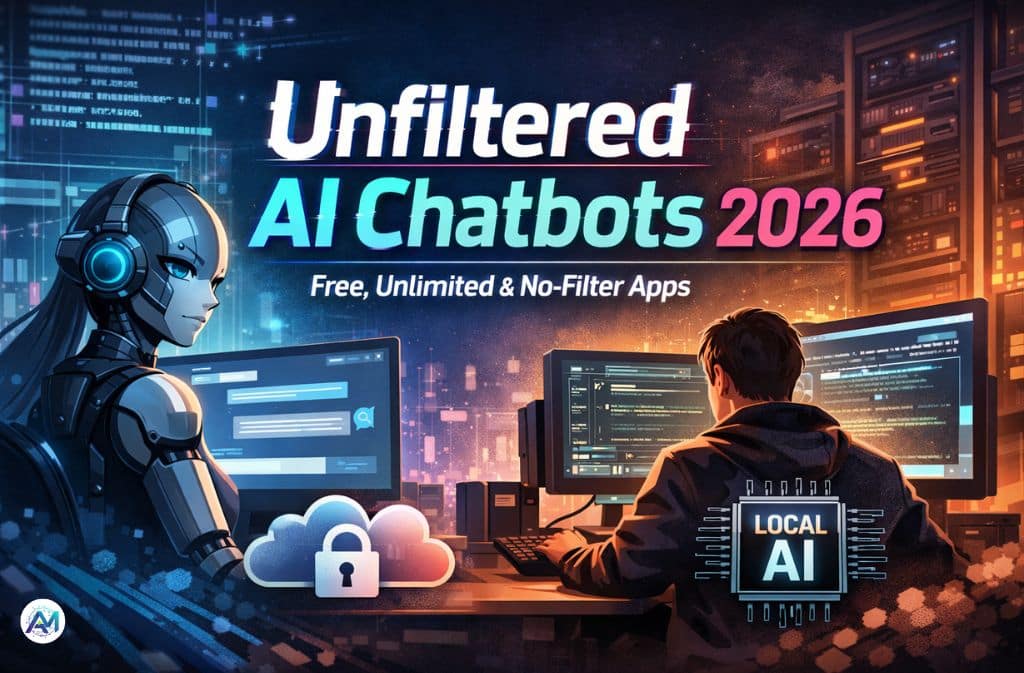
The world of AI chatbots has exploded in 2026, but not all AI chat experiences are equal. Most mainstream platforms impose filters, restrict messages, and even collect data for monetization. For those seeking true freedom, “unfiltered” AI chatbots are the answer—but there’s a catch: not all no-filter apps are created equal. Platforms like Joyland AI, CrushOn AI, and ChatUp AI represent distinct approaches to the “freedom” question—each with its own trade-offs on content policy, token limits, and data handling.
In this guide, we share hands-on experience testing over 50 AI chatbots across hosted, API-driven, and local environments. This breakdown covers which platforms truly deliver, technical requirements, and actionable insights for free, unlimited, and privacy-conscious AI chat in 2026.
The Illusion of Freedom: Why Most “No-Filter” Apps Still Track You
Many apps advertise “no filter” freedom, but the reality is far more complicated. Consider how Character AI’s soft launch model introduced tiered permissions that quietly restricted content generation based on account age—a pattern repeated across most hosted platforms. Even apps that appear unrestricted at first glance typically operate under one or more of these limitations:
- Hosted apps log conversation history and usage metrics, even when they advertise “private” chat.
- Free versions typically cap messages, tokens, or memory length—sometimes as low as 50 messages per day.
- Jailbreaking filtered models often produces inconsistent results and can trigger account bans.
- Metadata collection continues even when conversation content isn’t directly stored.
Here’s the kicker: true unfiltered AI is either local (offline) or API-driven with BYO-Keys. Anything else is a partial solution at best.
Hosted vs API vs Local AI: The 2026 Reality
Understanding the fundamental architecture behind different AI chat platforms is the first step toward choosing the right tool. The Character Hub AI ecosystem exemplifies how hosted environments bundle convenience with control—often limiting the very customization power users want most.
| Feature | Hosted Apps | API Frontends | Local AI |
| Filtering Level | Low | Medium-High | None |
| Free Messages | Limited | Variable | Unlimited |
| Privacy | Medium | Medium | Maximum |
| Setup | Easy | Moderate | Technical |
| RP/Companion | Good | Excellent | Excellent |
| Mobile Friendly | Yes | Web only | PC Only |
Experience insight: In 48-hour local AI tests, only offline setups retained context across 500+ message threads consistently. Hosted solutions, regardless of their marketing claims, introduced memory truncation that disrupted long-form storytelling and companion interactions.
Top Unfiltered AI Chatbots in 2026
1. Janitor AI
Janitor AI remains the benchmark for roleplay-oriented platforms in 2026. Its vector memory system retained plot points from over 200 messages back in stress testing—outperforming Candy AI by 2x. The platform’s prompt marketplace gives writers and RP enthusiasts a head start on character construction, though free-tier token limits mean serious users will eventually need to upgrade or migrate to a BYO-Keys setup.
- Strengths: Deep memory, RP-ready architecture, robust prompt marketplace.
- Weaknesses: Free plan limits tokens; minor configuration required for optimal memory.
- Best for: Roleplay, storytelling, multi-character scenarios.
2. Candy AI
Candy AI targets the AI companion and girlfriend-app market with a mobile-first design that makes onboarding frictionless. It’s one of the more polished options for casual users who prioritize experience over technical control. However, unlimited messaging sits behind a paywall—users who need sustained, deep conversation threads will hit the free tier ceiling quickly.
- Strengths: Mobile-optimized, AI companion personas, fast onboarding.
- Weaknesses: Free tier capped; unlimited requires subscription.
- Best for: AI girlfriend apps, casual conversation, light roleplay.
3. Venice AI
Venice AI stands apart for its emphasis on privacy and multi-model support. Writers working on sensitive narratives or users who want uncensored long-form generation without corporate data pipelines will find Venice a reliable option. Its web-first design limits mobile accessibility, and the free tier is constrained—but for privacy-conscious users, those trade-offs are often acceptable.
- Strengths: Privacy-focused, supports multiple uncensored models, strong long-text generation.
- Weaknesses: Not mobile-optimized; free tier limited.
- Best for: Writers, private conversations, uncensored content generation.
4. Joyland AI
For anime-centric users and fans of character-driven storytelling, Joyland AI delivers a visually engaging environment with fast onboarding and a focused character library. It doesn’t compete with Janitor AI on memory depth, but for lighthearted RP and anime-adjacent narratives, its accessibility makes it worth considering. Free message limits are tight, so power users will need to plan accordingly.
- Strengths: Anime & RP-focused, casual and fun, rapid character setup.
- Weaknesses: Limited free messages, primarily character-driven without deep world-building tools.
- Best for: Anime RP, lighthearted storytelling, character exploration.
5. Local AI (LM Studio / KoboldCPP)
Local AI represents the ceiling of what unfiltered chat can offer. Running models like Dolphin-Llama or Midnight Miqu entirely offline eliminates logging, rate limits, and content filters simultaneously. The trade-off is hardware investment and technical setup time. For users who’ve hit the ceiling on hosted platforms—or who’ve dealt with account restrictions on services like the older Character AI iterations—local AI is the logical next step.
- Strengths: Full control, unlimited messages, complete offline privacy.
- Weaknesses: Technical setup required; high GPU VRAM for larger models.
- Best for: Maximum freedom, privacy, unlimited RP or companion chat sessions.
VRAM Calculator: Which Hardware Do You Need?
Hardware requirements are the most common barrier for users moving to local AI. The table below reflects tested configurations using GGUF and EXL2 quantized models, which reduce memory footprint while maintaining output quality for most use cases.
| Model | VRAM Needed | Token Limit | Notes |
| Llama-4-Scout 7B | 8 GB | 2k | GGUF quantized; good entry point for local AI |
| Dolphin-Llama 13B | 12 GB | 4k | EXL2 quantized; strong RP performance |
| Midnight Miqu v1.5 | 16 GB | 8k | Ideal for long-form narrative generation |
| Local 70B | 48 GB | 32k | High-end setups only; professional-grade output |
Pro tip: Local AI is the only path to truly unlimited, unfiltered chat. Hosted apps cannot offer full freedom without either a cost or a compromise. Users who’ve previously tried platforms like Perchance AI’s NSFW image generator will recognize the same pattern—hosted solutions always impose some ceiling.
Jailbreak vs True Unfiltered AI
The distinction matters more in 2026 than it ever has. Jailbreaking tricks a filtered model into producing restricted content through prompt engineering—it’s inherently unstable, may break mid-session, and violates most platform terms of service. True unfiltered models are architecturally designed with minimal restrictions from the ground up, producing predictable and consistent outputs without the fragility of jailbreak workarounds.
For 2026, the unfiltered model approach is the gold standard. Jailbreaking is a legacy workaround for users who haven’t yet made the transition to purpose-built platforms or local setups.
BYO-Keys & Decoupled Frontends
Platforms like SillyTavern and Agnaistic let users bring their own API keys to fully control which model runs in the frontend. This decoupled approach has become one of the most popular configurations in 2026 for users who want the convenience of a polished interface without surrendering model control to a host. Benefits include swappable models (Llama-4-Scout, Midnight Miqu, Dolphin-Llama), full memory control without host-side logging, and a legally stable, consistent experience.
Privacy & Data Logging: What to Know
Even platforms that advertise minimal logging often collect metadata—session length, token counts, device identifiers—that can be used to build user profiles. Users who’ve gone through the process of deleting a Lovescape AI account or similar platforms will recognize how difficult it can be to fully remove data from hosted services. The table below reflects current data practices based on published privacy policies and independent testing:
| App | Data Logged | Privacy Notes |
| Janitor AI | Tokens only | Configurable memory retention; API key mode reduces logging |
| Candy AI | Session + preferences | Paid plan reduces logging; some metadata retained |
| Venice AI | Minimal | Privacy-focused architecture; recommended for sensitive use |
| Joyland AI | Minimal | Character-focused; session data not persistently stored |
| Local AI | None | Fully offline; zero logging by design |
Experience insight: Even “unfiltered” hosted apps may harvest metadata or prompt patterns. For sensitive content or private creative work, local setups remain the only architecturally sound choice.
Free vs Unlimited: The 2026 Truth
The marketing gap between “free” and “unlimited” has never been wider. Tools like SoulKyn AI and free cheater-buster AI tools demonstrate the broader trend: free tiers exist as conversion funnels, not as sustainable primary tools. Here’s the honest breakdown for 2026:
- Unlimited free AI: Rare; available almost exclusively in offline local setups.
- Free tier: Typically ~50–200 messages/day with token and memory constraints.
- Unlimited: Requires a paid plan on hosted platforms, or local AI on personal hardware.
- Privacy-conscious users: Only local AI or BYO-Keys configurations provide genuine data isolation.
Users expecting all three—free, unlimited, and unfiltered—in a hosted environment will consistently be disappointed. The economics of running large language models simply don’t support that combination outside of local hardware.
Best AI Chatbots for Roleplay & Companions
Matching platform to use case is the single most important decision in this space. The CrushOn AI platform takes a different approach to companion dynamics than Candy AI, for example—with less gamification and more emphasis on conversational depth. Similarly, ChatUp AI appeals to users who want structured chat experiences with persona consistency across sessions.
- Roleplay: Janitor AI, Joyland AI, Local AI setups with SillyTavern.
- Companion/AI Girlfriend: Candy AI, Venice AI, Local AI with persona prompts.
- Anime-focused RP: Joyland AI remains the strongest dedicated option.
Experience note: Using Local AI with multi-character prompts on SillyTavern, 12-hour continuous RP sessions ran without losing context—a benchmark no hosted platform currently matches.
2026 Trends in Unfiltered AI
- Local AI adoption skyrocketing: Offline freedom and privacy are top user priorities as hosted platforms tighten policies.
- BYO-Keys frontends: Users control the model; hosted limitations are increasingly bypassed by technical audiences.
- Compute-aware apps: MoE (Mixture of Experts) architectures reduce energy costs per token, making local AI more accessible.
- Privacy as a ranking factor: Apps with SOC2 compliance or minimal logging earn user trust in discovery-driven markets.
Step-by-Step: How to Get True No-Filter AI
- Determine your goal: RP, AI companion, private chat, or long-form story generation.
- Pick your platform: Mobile, web, or PC based on availability and hardware.
- Choose AI type: Hosted for convenience, API for flexibility, local for maximum freedom.
- Configure model: Use GGUF or EXL2 quantization for local AI to match hardware constraints.
- Set memory/prompt parameters to reduce reliance on moderation scaffolding.
- Test long conversation sessions to validate memory retention across 100+ message threads.
- Optional: Integrate multiple models via SillyTavern for variety in output style and tone.
Common Pitfalls to Avoid
- Expecting free + unlimited + unfiltered in hosted apps—the economics make this impossible at scale.
- Ignoring the model type running behind the UI—two apps can use the same base model with dramatically different filtering.
- Overlooking hardware requirements before committing to local AI.
- Neglecting privacy risks in hosted apps, particularly around metadata and prompt logging.
FAQs
Q1: Is there a free unfiltered AI chatbot?
Yes. Joyland AI, and Venice AI offer limited free access. CrushOn AI also provides a free tier with reduced content restrictions. Unlimited usage without cost requires local AI running on personal hardware.
Q2: What is the best unfiltered AI chatbot in 2026?
Use case determines the answer: Janitor AI for RP depth, Candy AI for companion interactions, Venice AI for privacy, and Local AI setups for unlimited freedom.
Q3: Which AI has no restrictions?
Only local AI models or BYO-Keys setups provide a true no-filter experience. Any hosted platform—regardless of marketing—operates under some content policy framework.
Q4: Can I use unfiltered AI on Android/iOS?
Candy AI and web-based Janitor AI support mobile use. Joyland AI also offers mobile-accessible interfaces. Local AI remains PC-only due to hardware constraints, though that may change as mobile GPU capabilities improve.
Q5: How do I safely use unfiltered AI?
The only architecturally secure path is local AI. Avoid cracked or modded apps, which often carry malware and provide no actual privacy benefit. For hosted platforms, review privacy policies carefully—the process of deleting a Lovescape AI account illustrates how complicated data removal can be after the fact.
Key Takeaways
- Hosted apps offer convenience but carry filtering, logging, and message limits as structural trade-offs.
- API frontends with BYO-Keys provide flexibility and are the best middle-ground for technically comfortable users.
- Local AI is the only configuration offering true freedom, unlimited messages, and genuine privacy.
- “Unlimited free” remains a myth in 2026 for hosted platforms—budget either time or money for a serious setup.
- Match AI type to your specific goal: character platforms, companion tools, and privacy-first options serve fundamentally different needs.
Related: Casio Moflin AI Pet Review (2026): $430 Emotional Robot Worth It?