
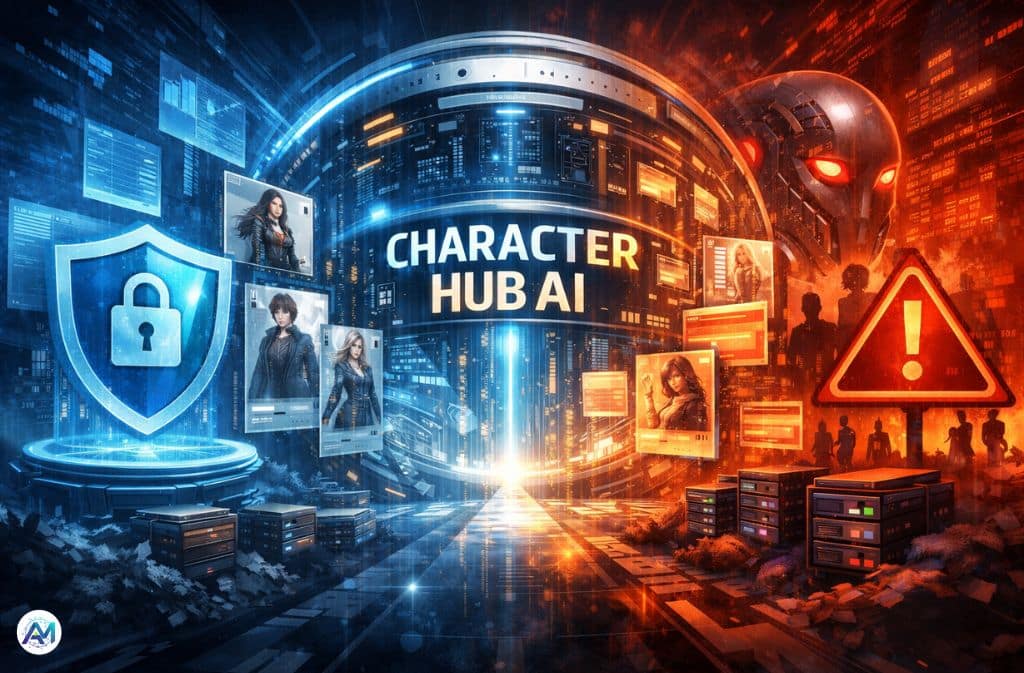
Character Hub AI sounds like a product. It isn’t.
By 2026, the phrase has become shorthand for a complex interaction between character archives, AI chat platforms, character-card standards, and large language model (LLM) runtimes. Some of these systems are safe for long-term character preservation. Others are optimized for rapid reuse, remixing, or training.
Understanding the difference is no longer optional.
If you’re a creator asking whether your characters are safe, whether AI is involved, or whether uploading an OC could cost you control later, this guide explains what “Character Hub AI” actually means, how modern character systems function in practice, and how creators responsibly use them in 2026.
Character Hub AI is an informal term used to describe how character archives, AI chat platforms, and character-card systems interact. CharacterHub.org itself does not generate characters or run AI models; it functions as a static archive that creators may optionally connect to third-party AI tools.
This distinction matters — legally, technically, and strategically.
What People Mean When They Say “Character Hub AI”
There is no single platform officially called Character Hub AI.
The phrase typically refers to one of three things:
CharacterHub.org, a non-AI character archive
AI character chat platforms that import or reference character cards
The workflow connecting archives to AI runtimes
Search intent clusters these together, but risk and function differ significantly.
The Critical 2026 Split: Social Character Cards vs Technical Character Cards
This distinction now underpins how Google, regulators, and creators evaluate safety.
Social Character Cards
Designed for sharing, visibility, and reuse.
Characteristics
Public discovery
Community remixing
Algorithmic exposure
Higher scraping probability
Common use cases
Roleplay communities
Prompt experimentation
Social engagement
Technical Character Cards
Designed for structured execution inside AI systems.
Characteristics
V2 Character Card Metadata
Explicit personality and constraint fields
Often paired with local or opt-in LLMs
Memory handled via retrieval, not accumulation
Common use cases
Controlled character testing
Private dialogue simulation
Long-form narrative development
This split is foundational. Treating one as the other causes most creator harm.
Where CharacterHub.org Fits in 2026
CharacterHub.org occupies a third category: archival infrastructure.
It does not:
Run AI models
Generate characters
Simulate dialogue
Retain conversational memory
Instead, it acts as a canonical storage layer — increasingly described by creators as a time capsule for original characters.
Why “Safe Hosting” Is Now a Feature
In an environment shaped by scraping, model training anxiety, and regulatory scrutiny, platforms with low extraction velocity carry lower risk.
CharacterHub.org’s value lies in restraint.
The 2026 Compatibility Layer: Connecting CharacterHub to LLM Backends
CharacterHub does not execute AI — but characters often move through it.
A common 2026 workflow:
Draft and archive the canonical character on CharacterHub
Keep the archive private or limited-visibility
Export a copy, not the source
Convert to V2 character card format
Inject personality at runtime
Retrieve lore via RAG, not memory accumulation
This separation preserves authorship and minimizes exposure.
V2 Character Card Metadata (Why It Exists)
Earlier card formats blurred personality, lore, and conversational residue.
V2 metadata separates:
Core personality
Behavioral constraints
Lore references
Context boundaries
This enables selective retrieval, not permanent storage — a design choice driven as much by regulation as by quality.
Lorebook RAG vs “Infinite Memory”
“Infinite memory” is no longer a neutral feature.
Infinite Memory
Persistent server-side logs
Retention ambiguity
Deletion complexity
Regulatory liability
Lorebook RAG (Preferred)
Lore stored separately
Retrieved only when relevant
No permanent conversational history
Easier compliance with deletion requests
In 2026, uncontrolled memory is a compliance risk, not an upgrade.
How Creators Safely Use CharacterHub in 2026
Responsible creator usage looks like this:
Archive canonical character drafts on CharacterHub
Keep characters private or limited-visibility
Export only copies to AI runtimes
Use V2 cards with local or opt-in models
Treat the archive as the source of truth
This pattern appears repeatedly among professional writers and long-running OC projects.
A Real Creator Failure Case (Why This Matters)
A writer uploaded a long-running OC to a public social hub to “test engagement.”
Within a day:
The character appeared in unrelated roleplays
Personality was flattened
Attribution was lost
Recovery required manual takedowns and proof of authorship.
The character wasn’t stolen — control was diluted.
That distinction matters, and it’s where most creators underestimate risk.
Who Should Avoid Social Character Hubs
Some creators should not use public, remix-oriented platforms at all.
Avoid social character hubs if you are:
Developing commercial IP
Writing under NDA
Managing a long-running OC universe
Unable to tolerate loss of control or attribution
This is not moral judgment — it’s risk alignment.
Regulation Reality: EU AI Act & TRAIGA Act
By 2026, “model training consent” is the core concern.
Modern requirements emphasize:
Explicit disclosure of training use
Clear separation between hosting and training
Deletion that includes metadata and cached sessions
Important: Regulatory interpretations continue to evolve; creators should treat consent language as dynamic, not static.
Vagueness is no longer neutral — it’s a signal.
The Right to Be Forgotten (Operational Test)
A compliant platform should answer yes to all three:
Can I delete the character?
Is metadata deleted as well?
Are cached LLM sessions purged?
If any answer is unclear, assume persistence.
Platform Safety Heatmap (2026)
| Platform | Native AI | Scraping Protection | Data Portability | Best Use Case |
|---|---|---|---|---|
| CharacterHub.org | No | High | High | Long-term OC archive |
| Chub.ai | Yes | Medium | Medium | Active roleplay & sharing |
| CharHub.ai | Yes | Low | Low | Casual experimentation |
| Backyard AI | Yes (Local) | Highest | Highest | Private testing |
Also Read: Joyland AI: The Viral AI Chat World Everyone’s Talking About
Platform Identity TL;DR
| Platform | Identity | AI Risk Profile |
|---|---|---|
| CharacterHub.org | Archive | Training-free hosting |
| Chub.ai | Social runtime | Community reuse risk |
| CharHub.ai | Chat sandbox | High exposure |
| Backyard AI | Local runtime | Maximum control |
Is Character Hub Safe for Original Characters?
As of 2026:
Yes, for hosting
Yes, for preservation
Yes, when used as a source of truth
Risk arises not from the archive, but from what you connect to it.
FAQs
Q. Is Character Hub AI a real product?
No. Character Hub AI is not an official product or platform. The term is commonly used to describe how character archives like CharacterHub.org connect with AI chat platforms, character-card systems, and LLM runtimes. It refers to a workflow ecosystem rather than a single tool or service.
Q. Does CharacterHub.org use AI to generate characters?
No. CharacterHub.org does not generate characters or run artificial intelligence models. It functions as a character archive where creators store and organize original characters. Any AI interaction happens only when users export character data to third-party AI platforms or local AI runtimes.
Q. Is Character Hub the same as Chub AI or CharHub AI?
No. These are completely different platforms.
CharacterHub.org: Character archive and preservation platform
Chub AI: Social AI roleplay and character sharing platform
CharHub AI: AI chat experimentation sandbox
Each platform has different privacy levels, AI exposure risks, and content reuse policies.
Q. Can my characters be used for AI training?
Your characters can only be used for AI training if the platform you upload them to explicitly allows training usage. CharacterHub.org itself does not train AI models. However, some AI chat or social character platforms may use uploaded content to improve models depending on their terms of service.
Q. What is V2 Character Card Metadata?
V2 Character Card Metadata is a structured format used in modern AI character systems. It separates key elements such as personality traits, behavioral rules, lore references, and context limits. This improves AI response accuracy while giving creators more control over how characters behave during AI-driven conversations.
Q. What is Lorebook RAG?
Lorebook RAG (Retrieval-Augmented Generation) is a system that stores character lore separately from conversation memory. The AI retrieves relevant lore only when needed instead of permanently storing it. This approach improves privacy, reduces memory drift, and helps maintain consistent character behavior in AI chats.
Q. Is infinite memory safe in AI character platforms?
Infinite memory is not always safe. Many AI platforms store conversations permanently, which can create privacy, ownership, and deletion challenges. Safer systems use retrieval-based memory like Lorebook RAG, which limits long-term data storage and allows better compliance with data deletion and consent regulations.
Q. Can I use CharacterHub with mobile AI chat apps?
Yes. CharacterHub characters can be used with mobile AI chat by exporting character cards and running them through local AI apps or Progressive Web App (PWA) chat interfaces. This allows creators to test and interact with characters privately while maintaining control over stored character data.
Final Takeaway
There is no universally “safe” character platform in 2026.
There are only platforms that:
Disclose AI usage
Respect consent
Support deletion
Align with your intent
CharacterHub.org’s strength is restraint.
In a landscape built for extraction, that restraint is increasingly valuable.
Related: CrushOn AI Review 2026: Is It Safe, Free, or Worth It?