

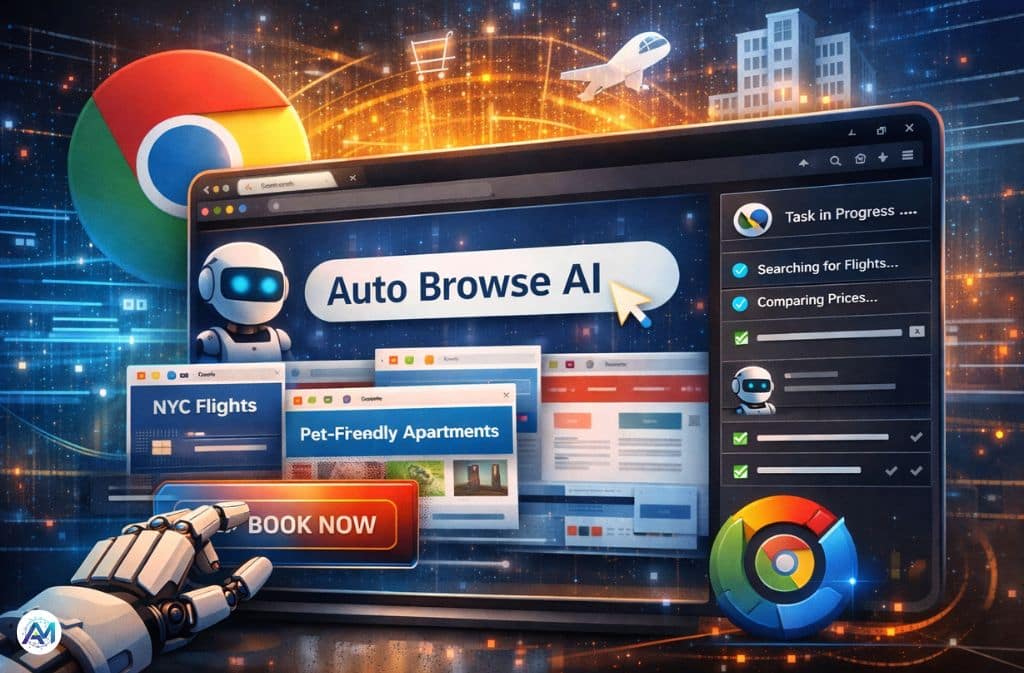
Google is officially transforming Chrome from a passive web browser into an active AI operator.
Starting today, the company is rolling out Auto Browse, a new agentic AI feature that allows Chrome to navigate the web on a user’s behalf — clicking links, opening pages, filling forms, and completing multi-step tasks with minimal human input.
It’s one of the clearest signals yet that the future of browsing isn’t about searching the web — it’s about delegating it.
From browser to operator
Auto Browse is powered by Google’s latest Gemini model and lives directly inside Chrome through the existing Gemini sidebar. Instead of returning links or summaries, the AI can now perform real actions across live websites.
Users can issue commands like:
“Find the cheapest flight to Dubai next month”
“Compare pricing for these three software tools”
“Look for apartments that allow pets under $1,200”
Once activated, Chrome opens a dedicated agent tab where the AI begins navigating the web step by step — scrolling pages, opening results, and gathering information in real time.
Unlike traditional automation tools, Auto Browse doesn’t rely on prebuilt scripts. It adapts dynamically to different layouts, websites, and page structures, behaving much more like a human user.
Visibility and control built in
Google says Auto Browse was designed to remain transparent and interruptible.
As the agent works, users can watch its actions live inside Chrome. For sensitive steps — such as logging into accounts, submitting personal information, or confirming purchases — the system pauses and asks for explicit approval before proceeding.
The company is positioning this as “human-in-the-loop autonomy,” aiming to balance convenience with control.
In practice, it’s Google’s attempt to make autonomous browsing feel safe enough for everyday use — not just demos.
Part of a larger agent push
Auto Browse isn’t launching in isolation.
Over the past year, Google has steadily expanded Gemini’s role inside Chrome, adding page summarization, cross-tab comparisons, image generation tools, and contextual assistance. Auto Browse takes that evolution one step further by allowing AI to act — not just advise.
The move places Chrome directly into the growing category of agentic AI systems, where software doesn’t simply respond to prompts but carries out tasks independently.
This also puts Google into more direct competition with emerging AI browsers and standalone agents that aim to replace manual web workflows entirely.
Why this matters
For decades, browsers have existed as neutral windows to the internet.
Auto Browse challenges that model.
If AI agents can navigate websites, compare options, and complete tasks faster than humans, the web itself begins to change. Websites may increasingly interact with machines instead of people — and traditional SEO, interfaces, and user flows could start to matter less.
This is the same shift already reshaping SaaS tools, productivity software, and customer support. Chrome is simply the first mainstream browser to make it unavoidable.
Who gets access first
Auto Browse is initially rolling out to Google AI Pro and AI Ultra subscribers on desktop Chrome. Google says broader availability is planned, though no public timeline has been announced.
For now, the feature remains opt-in and limited to supported regions.
Still, its arrival marks a turning point.
Chrome is no longer just where you browse the internet.
It’s becoming something that browses it for you.
Visit: AIMetrix