
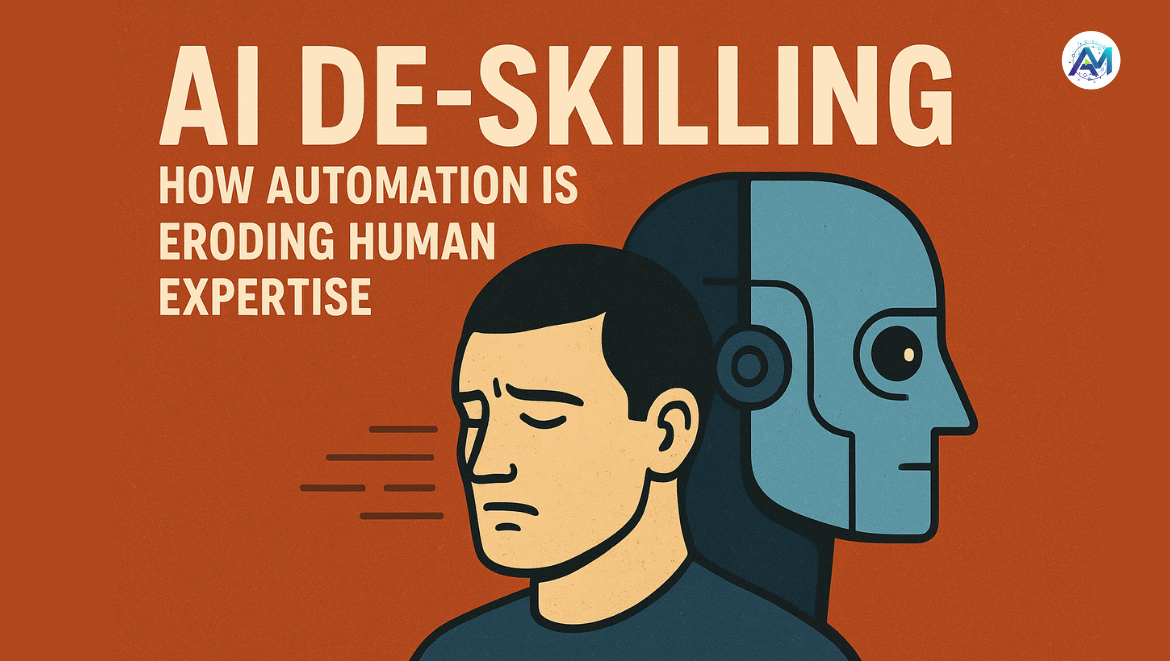
Artificial intelligence was supposed to make us smarter. In some ways, it has — we write faster, analyze quicker, decide sooner. But look closely, and something quieter is happening beneath the noise of progress: we’re starting to forget how to do the things machines now do for us. This slow erosion of ability is what experts are calling AI de-skilling.
You can see it almost everywhere. Students ask chatbots to summarize novels they never actually read. Junior doctors rely on algorithms to flag tiny shadows in medical scans. Even programmers — the very people who built this technology — now let code generators finish their thoughts.
At first, it feels like freedom. Then you realize the muscle memory is gone — the human skill replaced by automation’s easy efficiency.
The Subtle Cost of Automation
Philosopher Kwame Anthony Appiah has a term for this: de-skilling. He’s not talking about mass unemployment or apocalyptic job loss — he means something more intimate. The small erosion of ability that happens when a machine takes over a task we once practiced ourselves. In today’s context, AI de-skilling is that quiet drift from expertise to dependency.
There’s evidence it’s already happening. In one British study, frequent AI users scored noticeably lower on tests that measure reasoning and critical thinking. In another, doctors who’d grown accustomed to AI-assisted colonoscopy tools missed more cases when the software was turned off. The longer the support lasted, the more fragile their solo skills became.
We’ve Been Here Before — Just Not Like This
Technology has always changed what we know how to do. We don’t memorize phone numbers anymore; we don’t sew our own clothes. But those were small, selective losses. What AI de-skilling threatens to hollow out now isn’t manual skill — it’s judgment.
A pilot who spends months on autopilot still knows the checklist, but not the feel of the stick. A writer who edits AI drafts may lose her own rhythm. Slowly, imperceptibly, we stop noticing what used to matter most: the thinking that happens between the keystrokes.
This is the deeper cost of automation and artificial intelligence — not lost jobs, but lost mastery.
When Help Becomes Habit
Not all of this is bad. Many professionals are learning new kinds of fluency. Programmers who work with AI copilots spend more time reviewing, testing, and refining — a shift from production to supervision. The key is awareness.
Trouble starts when “human in the loop” becomes “human on standby.” Oversight without curiosity. Approval without thought. The system hums along, and we nod, trusting that the math inside the black box is probably right. That’s when AI de-skilling turns into something more dangerous — automation replacing not just labor, but learning.
A Lesson From the Classroom
Teachers see the effects first. Some have banned AI tools outright; others have tried to weave them into assignments. One Harvard experiment found that students who used a structured AI tutor learned faster — but only when they were asked to question and correct its answers. Left unchallenged, the same system quietly encouraged laziness.
This is how AI de-skilling in education begins — when convenience replaces comprehension. It’s a delicate balance: use the machine, but don’t let it think for you.
Keeping the Human Edge
There’s a temptation to treat all this as inevitable, as if every new technology must reshape the human mind. Maybe it does. But the antidote is simple enough: keep doing the hard parts yourself sometimes. Write by hand. Read without a summary. Diagnose without the screen.
Because what artificial intelligence still can’t do — what it may never do — is care about being right. That impulse, that flicker of responsibility, is ours alone.
If the future belongs to hybrid intelligence, the human part has to stay awake. That means resisting AI de-skilling — and keeping our curiosity, judgment, and creativity alive.
Visit: AIMetrix