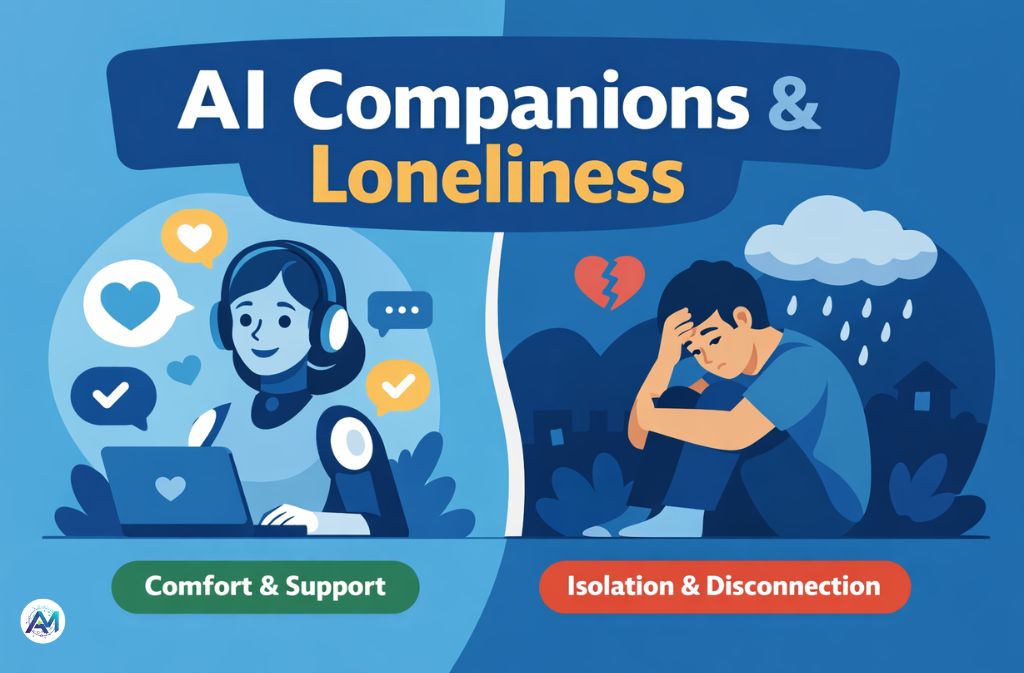
Loneliness has become one of the defining emotional conditions of the 2020s. It’s no longer limited to the elderly or socially isolated. It shows up in young professionals, remote workers, students, caregivers, and increasingly, people who are surrounded by others but still feel emotionally unseen.
Against that backdrop, AI companions have stepped into a role that feels both practical and intimate. They listen instantly. They respond without judgment. They are always available. For many users, especially during periods of stress or isolation, that can feel like relief.
But relief is not the same as connection.
This article examines what AI companions genuinely help with, where their limits appear, and how to use them in ways that support — rather than quietly replace — human relationships.
The Short-Term Effects: Why AI Companions Often Feel Helpful
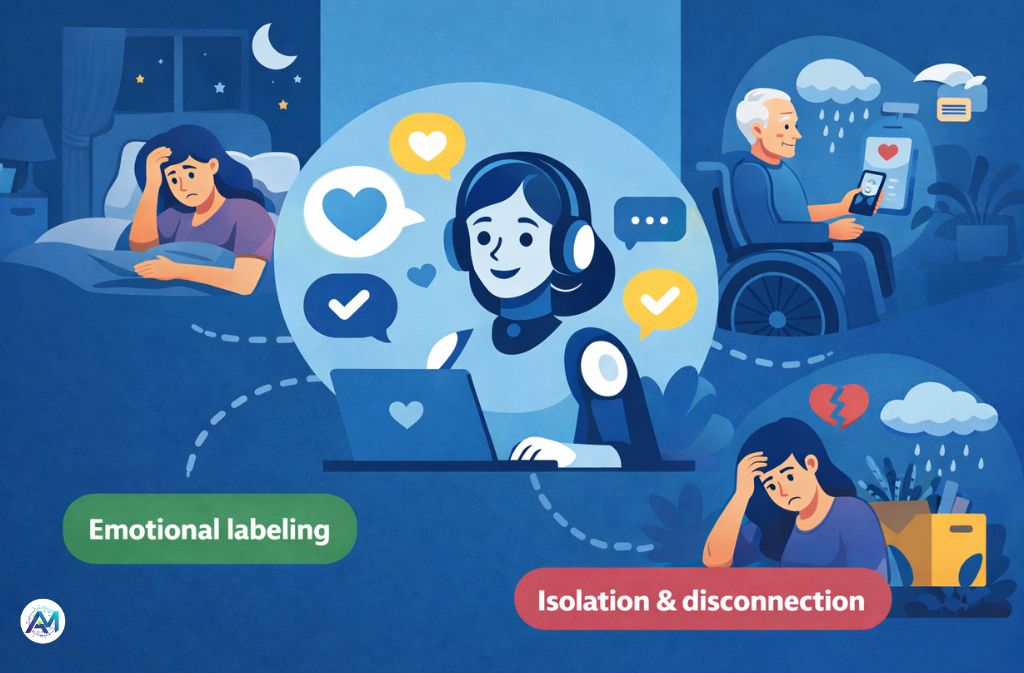
For many users, the first experience with an AI companion is surprisingly grounding.
You speak. Something responds thoughtfully. There’s no awkward pause, no social risk, no need to manage another person’s emotions. That alone can reduce anxiety.
Behavioral research published in the Journal of Consumer Research consistently shows that structured conversational agents can reduce self-reported loneliness and emotional distress in the short term — with one multi-study analysis finding that AI companions alleviate loneliness on par with interacting with another person, and more than passive activities like watching videos. This was particularly true when users felt genuinely heard, not merely responded to.
Short-term benefits are most consistently observed when AI companions are used for:
- Emotional labeling (“What I’m feeling might be stress, not failure”)
- Rumination interruption
- Night-time or off-hours support
- Situational reassurance during high-anxiety moments
A 2025 peer-reviewed study in the Journal of Medical Internet Research found similar patterns among university students — AI social chatbots reduced loneliness and social anxiety over a four-week period, with users consistently reporting that the non-judgmental quality of the interaction was the primary driver of relief.
This is especially relevant for:
- Older adults with limited mobility
- People with chronic illness or disability
- Caregivers experiencing emotional fatigue
- Individuals going through acute transitions (grief, relocation, burnout)
Used this way, AI companionship functions less like a relationship and more like emotional scaffolding.
What the Research Does Not Claim
It’s important to slow down here.
While some studies report large reductions in depressive symptoms — figures as high as 40–50% improvement in certain trials — these results come from specific, time-limited interventions using structured emotional regulation bots, often alongside other supports.
They do not show that open-ended AI companionship replaces human relationships.
They do not demonstrate long-term social improvement by itself.
And they do not prove causation between AI use and emotional health over years.
The benefit is real — but narrow.
The Reciprocity Gap: Where AI Connection Breaks Down
The most important limitation of AI companionship isn’t technical. It’s psychological.
Human relationships involve reciprocity:
- Both people risk being misunderstood
- Both can withdraw
- Both are emotionally affected by conflict or honesty
AI doesn’t experience any of that.
It cannot feel hurt.
It cannot need you.
It cannot leave because you disappointed it.
This creates what behavioral researchers increasingly refer to as a reciprocity gap — an interaction where emotional output flows one way, without mutual vulnerability. A 2025 political economy analysis in New Media & Society argues that AI companions are structurally designed to replace negotiated connection with guaranteed affirmation — an arrangement that feels supportive but trains users to expect frictionless emotional transactions that human relationships cannot and should not replicate.
At first, this feels safe.
Over time, it can subtly reshape expectations.
The Long-Term Risks (What the Evidence Suggests, Not Proves)
Longitudinal data on AI companionship is still emerging, but the picture is more nuanced than either advocates or critics tend to acknowledge. Research from George Mason University’s College of Public Health reviewed a four-week randomized controlled trial showing that while certain AI features modestly reduced loneliness, heavy daily use correlated with greater loneliness, increased dependence, and reduced real-world socializing — even among users who reported initial relief.
Across observational studies and ethical reviews, several patterns appear consistently:
- Reduced tolerance for interpersonal friction
- Increased avoidance of emotionally uncertain situations
- Preference for predictable affirmation over negotiated connection
- Declining motivation to repair strained human relationships
These are correlations, not confirmed causal effects. But they align closely with what we already know from social development research and digital dependency studies.
The concern isn’t that AI causes loneliness — it’s that, without boundaries, it can make avoidance more comfortable.
A Closer Look at Younger Users (Especially Young Men 18–30)
One demographic deserves specific attention.
By 2026, usage data and behavioral research increasingly highlight young men aged 18–30 as a primary user group for AI romantic and companion systems. Analysis from the American Institute for Boys and Men frames this with unusual clarity: AI companions function like digital painkillers for this group — capable of providing real relief, but also capable of delaying the development of coping skills and suppressing the motivation to pursue real-world connection.
This group already faces:
- Declining in-person social participation
- Higher rates of social withdrawal
- Cultural pressure to self-regulate emotionally without support
For these users, AI companionship — including platforms like CrushOn AI that are designed around emotionally responsive personas — can feel like the first space where they are genuinely heard without judgment.
The risk here is not immediate harm — it’s substitution over time.
Researchers caution that heavy reliance during key developmental years may reduce opportunities to practice conflict negotiation, emotional ambiguity, and mutual vulnerability. These risks are projected, not universally observed. Many users engage healthily. But the developmental window matters.
AI Companions vs. Human Connection: A Practical Comparison
| Aspect | AI Companion | Human Relationship |
|---|---|---|
| Availability | Always on | Limited |
| Emotional risk | None | Mutual |
| Conflict | Avoidable | Inevitable |
| Validation | Guaranteed | Negotiated |
| Growth pressure | Low | High |
| Long-term resilience | Limited alone | Strong |
This isn’t an argument against AI. It’s a reminder of what kind of support each offers.
The Bridge Method: Using AI Without Replacing People
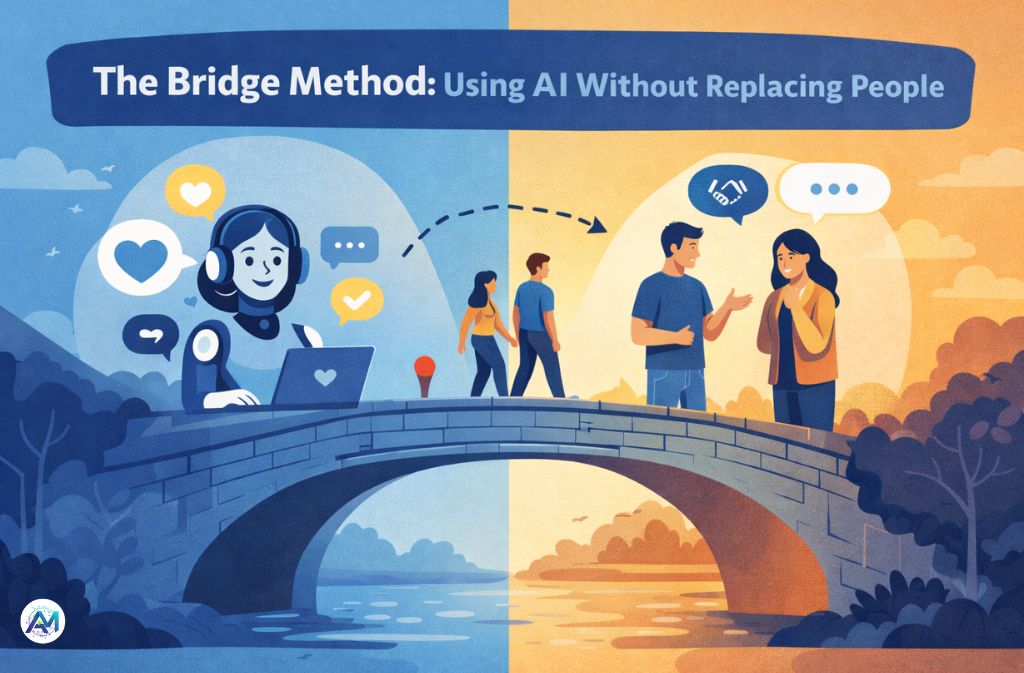
Instead of asking whether AI companionship is “good” or “bad,” a more useful question is:
Does it help you move toward people — or away from them?
The Bridge Method treats AI as a transitional support, not a destination. Some platforms are structured with this in mind — ChatUp AI, for instance, focuses on guided conversation patterns that help users clarify what they’re feeling before taking that into real-world interactions, rather than endlessly circling the same emotional loops.
Healthy use looks like:
- Clarifying emotions before a human conversation
- Rehearsing difficult discussions
- Calming anxiety so action becomes possible
- Reflecting after real interactions
Warning signs include:
- Choosing AI over reaching out every time
- Avoiding disagreement because AI feels easier
- Using AI primarily for emotional validation
- Feeling less motivated to engage socially
A simple check:
After using this, do I feel more capable of dealing with people — or less inclined to try?
Common Misconceptions
“AI companions are making people lonely.”
Not supported. They often serve people who are already lonely. The ScienceDirect research on Danish high-school students found that social-supportive chatbot users reported significantly more loneliness than non-users — not because chatbots caused their isolation, but because lonely individuals were seeking them out.
“They’re just like friends.”
They simulate conversation, not mutual investment.
“If it helps, there’s no downside.”
Short-term benefit doesn’t guarantee long-term neutrality.
Can AI Companions Replace Human Connection?
No — and most research agrees on this point.
AI companions can support emotional regulation and reduce distress, but they cannot replace mutual accountability, shared risk, or the experience of being genuinely needed by someone else.
They can help people prepare for connection.
They cannot be connection in the human sense.
The Likely Future (2026 and Beyond)
The trajectory isn’t replacement — it’s integration.
We’re already seeing:
- AI used alongside therapy, not instead of it
- Companions embedded into social skill training programs
- Guardrails designed to discourage emotional dependency
- More transparent disclosures about AI limitations
Newer platforms like SoulKyn AI reflect a design philosophy increasingly oriented around this integration model — using AI interaction as a way to help users understand their own emotional patterns rather than simply satisfy them in the moment.
The healthiest future isn’t one where people choose between AI and humans — but where AI helps people stay connected to the world they already live in.
Final Thought
AI companions aren’t dangerous because they feel supportive.
They’re risky only when they become the only place support is felt.
Used intentionally, they can reduce emotional friction, increase self-understanding, and make real connection easier — not harder.
That distinction matters more than any percentage, headline, or hype cycle.
Related: AI Therapy Chatbots Are Listening — But Do They Really Care?
This article is for informational purposes only and does not replace professional mental health care. If you are experiencing persistent loneliness, depression, or emotional distress, consider seeking support from a licensed mental health professional.